The Foreign Ministry reiterated its condemnation of the unilateral maneuvers by London and Israel in the Sea Lion field, located on the Argentine continental shelf
The Foreign Ministry emphasized that any unilateral activity of exploration or exploitation of natural resources in disputed territories contravenes United Nations General Assembly Resolutions 2065 (XX) and 31/49. In this regard, the statement stressed that the rejection "extends to all related acts linked to the progress toward the productive phase of the project", including the alleged island regulations, exploitation concessions, and the hiring of suppliers.
The Government also recalled the current sanctions:
Rockhopper Exploration Plc was declared clandestine and disqualified for 20 years by Resolution 133/2012 of the Secretariat of Energy.
Navitas Petroleum LP received identical sanctions by Resolution 240/2022, after operating without authorization in Argentine jurisdiction.
"The Argentine government reiterates that it doesn't recognize the competence or jurisdiction of any authority other than its own," the Foreign Ministry stated, warning that those who participate in these illicit activities will be subject to administrative, legal, and judicial sanctions both in the country and at the international level.
The statement went even further: "The new announcements (...) constitute a unilateral act with potentially irreversible future effects (...) The Argentine Republic will deepen its action plan in order to adopt any additional measures it deems necessary to safeguard its sovereign rights and interests."
The rejection was also supported by the province of Tierra del Fuego, which described the British actions as "unilateral, illegal, and provocative." The Secretary of Malvinas, Antarctica, and International Affairs, Andrés Dachary, called for the immediate convening of the National Council of the Islands and warned: "This is the material plundering of resources that belong to the people of Tierra del Fuego and all Argentines (...) It is imperative to activate criminal and administrative sanctions."
Navitas's exploratory activities had already been questioned in 2023 and, in 2022, the company received a 20-year sanction for operating within the Argentine continental shelf, which prompted complaints to both the United Kingdom and Israel.
In a new display of diplomatic firmness, the Argentine Foreign Ministry rejected on Thursday the "alleged Final Investment Decision" announced by Rockhopper Exploration Plc—a British company—and Navitas Petroleum Development and Production Limited—an Israeli company—to move forward with the exploitation of the Sea Lion offshore field, located in the Northern Malvinas Basin. Both companies, the Government recalled, have already been formally sanctioned for operating on the Argentine continental shelf without authorization.
The official statement, released by the Ministry of Foreign Affairs, was unequivocal: "The Argentine Republic expresses its strongest rejection of the alleged 'Final Investment Decision' (...) without having the permits from the competent Argentine authority." The Executive's position is based on international law and on United Nations resolutions that recognize the existence of a sovereignty dispute with the United Kingdom.
Cancillería Argentina rechazó la ilegítima explotación extranjera en las Malvinas.
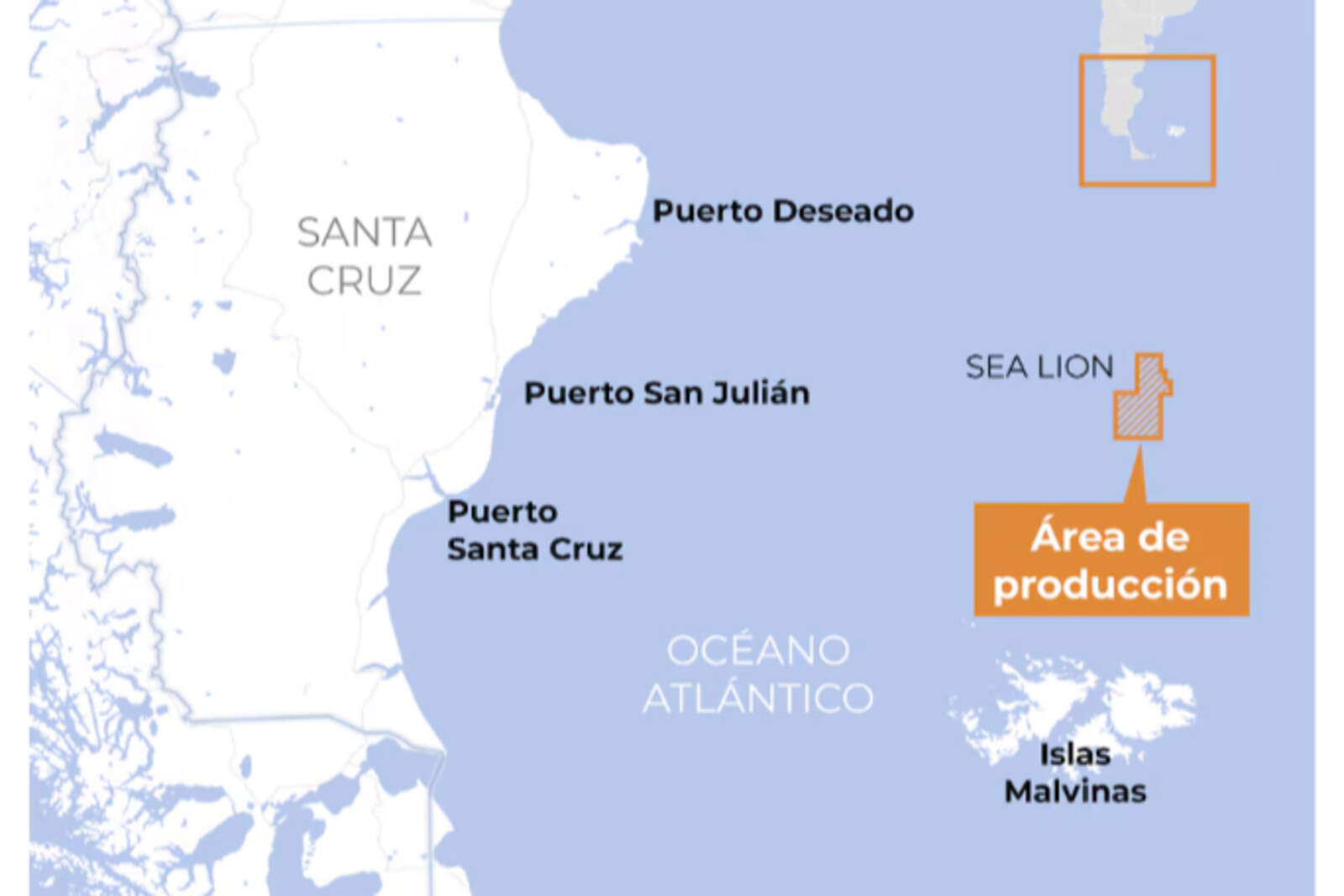
The Sea Lion project is considered one of the most ambitious oil developments of recent decades in the South Atlantic. The field, discovered in 2010, is located about 220 kilometers (137 miles) north of the archipelago and off the coast of Santa Cruz, in line with Puerto Deseado, Puerto San Julián, and Puerto Santa Cruz. It is estimated that it could contain around 819 million barrels of oil, although British studies raise that potential to 1.7 billion.
In fact, The Telegraph highlighted that the size of the field far exceeds Rosebank, the largest planned development in the North Sea, which would be around 300 million barrels. Navitas Petroleum reported on the Tel Aviv Stock Exchange that it will allocate US$1.17 billion for the first stage of the project, a figure that has raised alarms in our country due to the unilateral advance.
Economic reports reveal that the exploitation of Sea Lion could add US$10 billion to the GDP of the islands and generate US$3.75 billion in fiscal revenue, a disproportionate magnitude for a territory whose current economy relies on fishing, sheep farming, and tourism, with just over 3,500 inhabitants.