
The information becomes known in a context marked by strong volatility due to the legislative elections on October 26
Compartir:
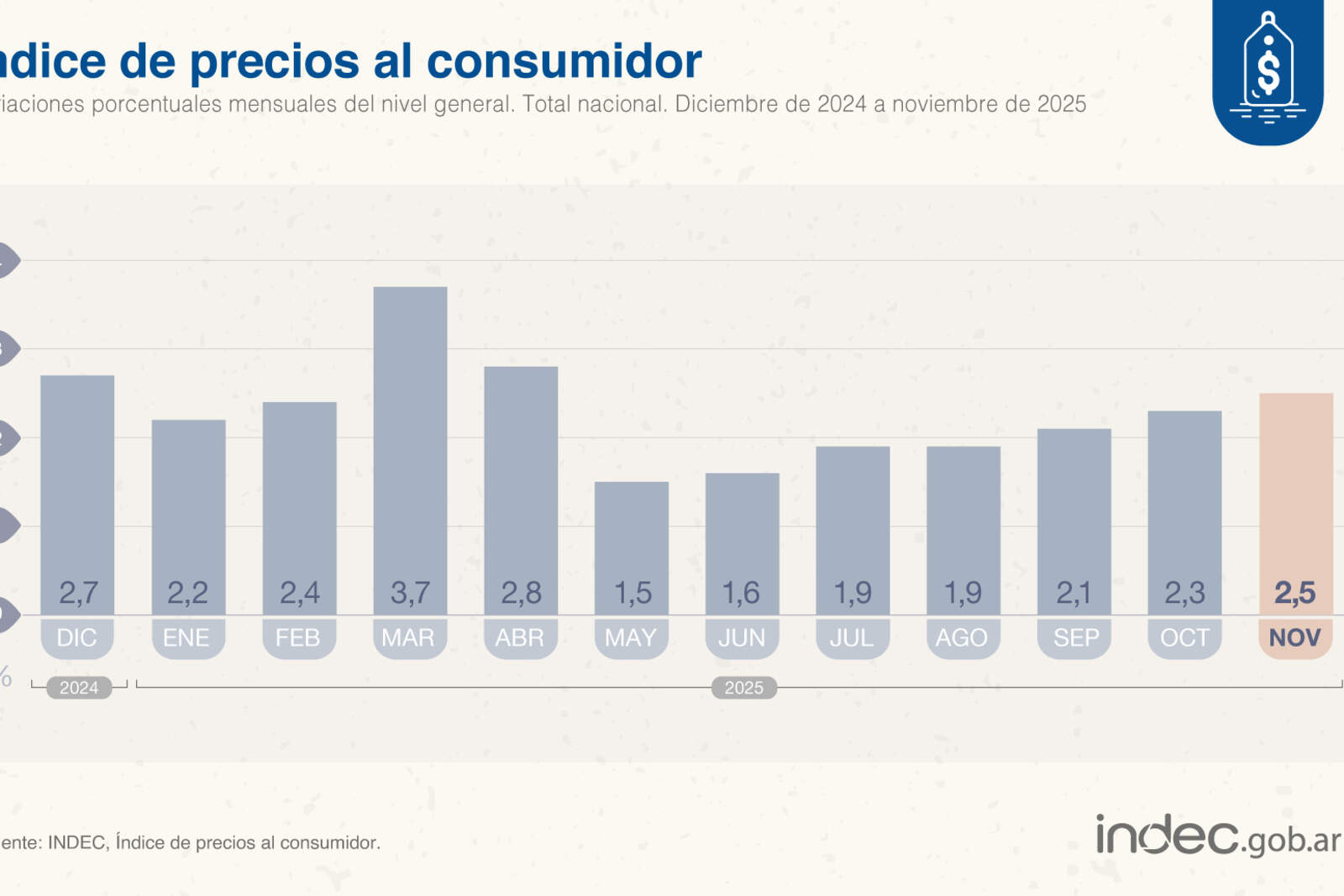
The National Institute of Statistics and Censuses (Indec) reported that November inflation was 2.5%, a figure that shows a slight variation compared to the 2.3% recorded in October, but continues to consolidate the year-on-year downward trend that the country has maintained since the inauguration of Javier Milei's government.
This figure comes in a context marked by strong volatility due to the legislative elections on October 26 and the "Kuka Risk," which caused uncertainty in expectations due to fears of a possible victory by Kirchnerism, which, according to analysts, explains much of this month's index movement.
Despite this temporary pressure, the Consumer Price Index showed a year-on-year variation of 31.4%, significantly lower than in previous months and years, and an accumulated 27.9% so far in 2025, a sign of the success of the fiscal and monetary anchor applied since the beginning of Milei's administration.
In addition, the monthly figure is 10 times lower than the 25.5% left by Kirchnerist minister Sergio Massa in December 2023, and the year-on-year figure is 6.7 times lower than the 211.4% recorded in the same month.
Datos del INDEC.
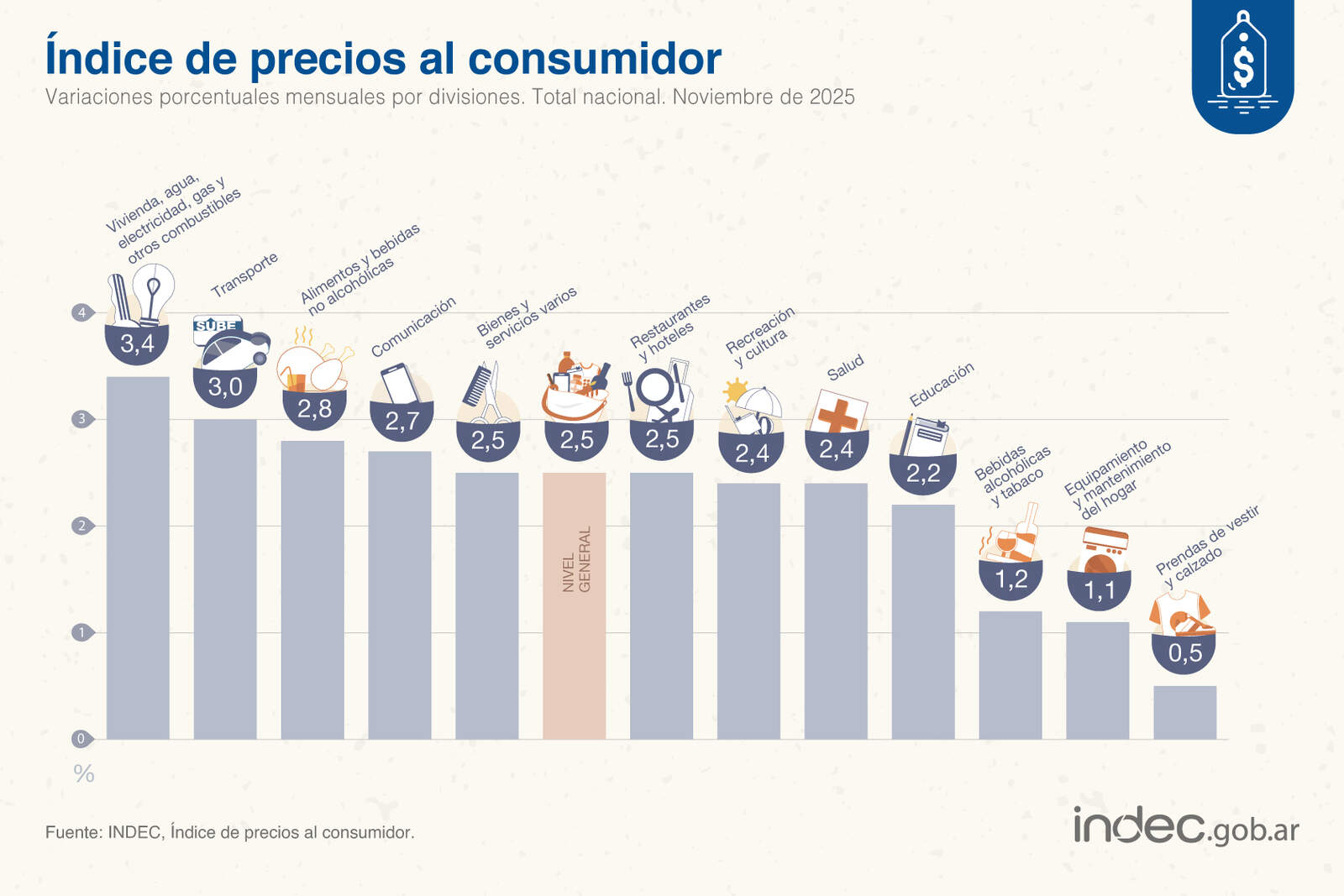
According to Indec, the division that increased the most in November was Housing, water, electricity, gas, and other fuels (3.4%), mainly driven by regulated adjustments, followed by Transportation (3%). In contrast, the smallest variations were seen in Household equipment and maintenance (1.1%) and Clothing and footwear (0.5%).
The national figure was released after the preliminary report from the City of Buenos Aires, where November inflation stood at 2.4%, with a month-on-month acceleration of 0.2 percentage points. That figure already indicated that the national index would not be significantly affected.

Datos del INDEC.
Meanwhile, days before the retail figure was published, Milei's economic team had highlighted the performance of the October wholesale index, which stood at 1.1%, an exceptional figure in a context of volatility linked to the electoral process. This behavior shows that inflation continues to decline and that the specific peak in November is due to the political climate and not to structural problems.
Projections for the end of the year and the first quarter of 2026 reinforce this view. Consulting firms surveyed by the Central Bank estimate that December inflation would fall to 2.1%, while between January and April of next year prices would move between 1.9% and 1.5%.
This time, the volatility prior to the legislative elections affected the 2.5% in November, but without reversing the downward trend, which for Milei's administration confirms that the anti-inflationary program is on the right track.