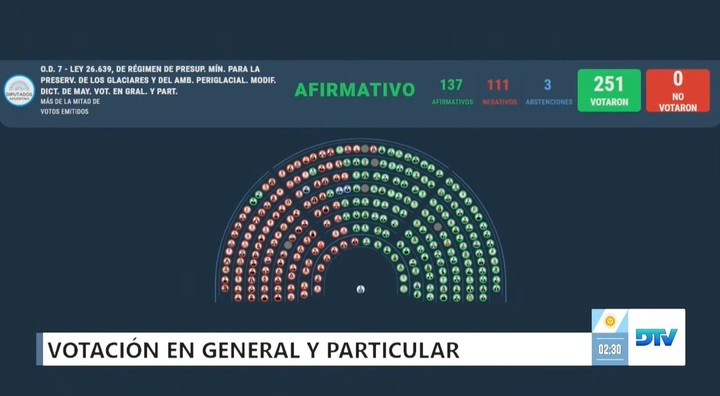
The final approval of the reform of the Glacier Law was celebrated by the mining sector as a turning point for the Argentine economy. With 137 affirmative votes, 111 negative votes and 3 abstentions, the Chamber of Deputies signed into law an amendment long called for by productive provinces
and industry.
Different private estimates argue that the new regulatory clarity could help unlock investments of between $30 billion and $40 billion, focusing on large copper projects that had been slowed down or delayed due to the lack of precise definitions of the scope of the periglacial environment.
The enactment of the law generated great expectations in the sector.
The Argentine Chamber of Mining Companies (CAEM) emphasized that the reform does not eliminate environmental protection, but rather makes it more precise. The entity stressed that it will now be possible to identify more clearly which areas should be preserved and in which productive activity can be carried out under strict environmental, technical and control standards
.
That was, precisely, one of the main demands of the industry and of the governors of the Cordilleran provinces: to end with a diffuse drafting that for more than a decade put strategic projects on hold. Among the developments that could gain momentum are Vicuña, El Pachón and Los Azules in San Juan, as well as MARA in Catamarca and Taca Taca in Salta, all linked
to the expected growth of copper. The legislative victory of the Government will mean a great productive leap for the country.
The ruling party won a legislative victory with a high economic impact. The reform aligns environmental protection with a more concrete technical criterion and reinforces the role of provinces in validating protected areas, a key point for moving towards real productive federalism. Faced with resistance from environmental sectors and part of the opposition, the Government managed to impose a more rational logic
.
For the mining industry, Argentina is beginning to offer a more predictable framework for competing for global capital in critical minerals. And in an international context in which copper, gold, lithium and uranium are gaining centrality, the new Glacier Law can become a decisive piece in transforming geological potential into concrete and sustained growth in