It is a self-proclaimed 'libertarian' micronation on a former military platform in the North Sea
Compartir:
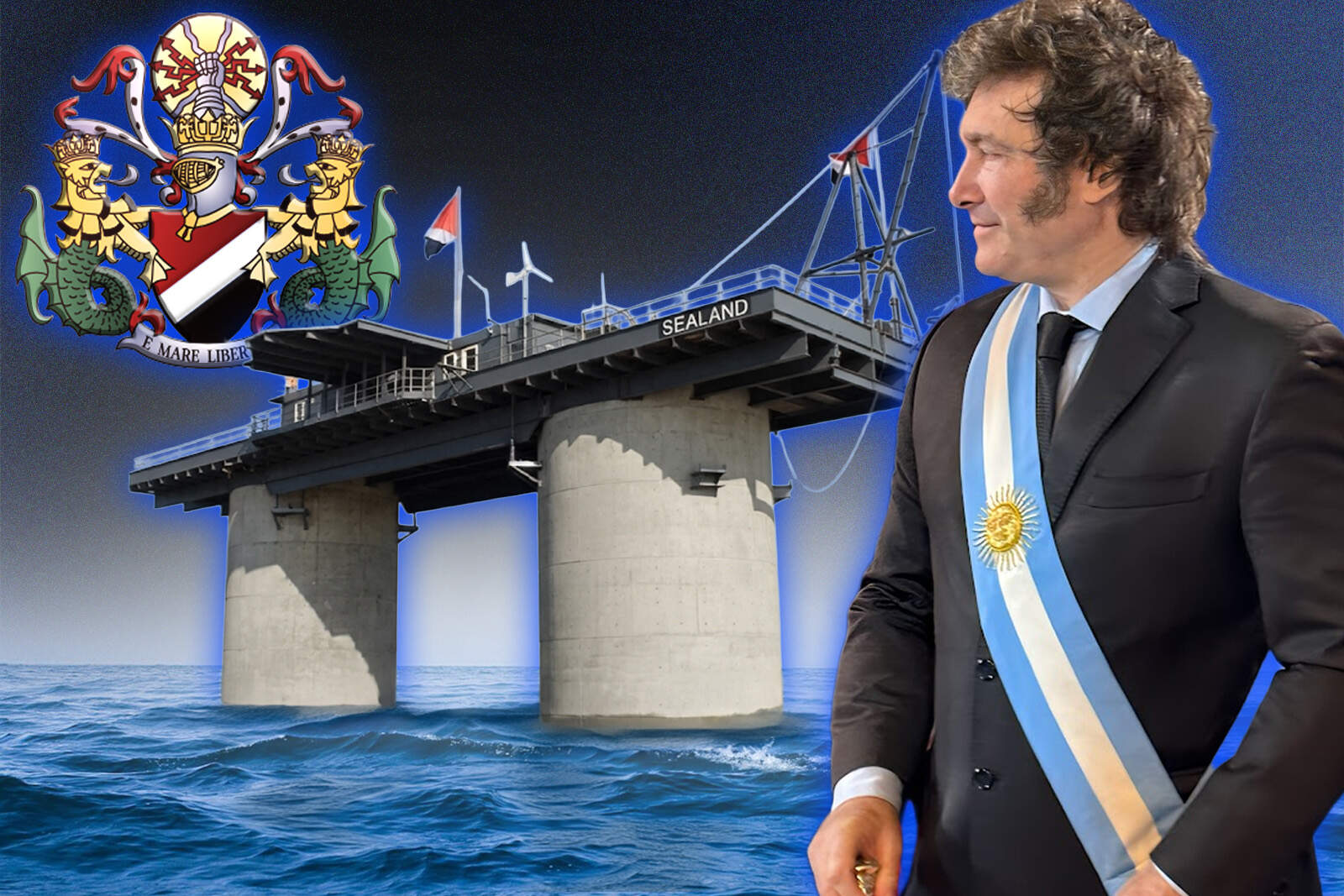
Principality of Sealand, a self-proclaimed micronation on an old military platform in the North Sea, published an article explicitly addressed to the Government of Javier Milei in which it requested that Argentina formally recognize its sovereignty.
In the text, Sealand keeps that Argentina's current political context and the President's ideological profile turn that "recognition" into a strategic decision of high impact and low political cost.
According to the article, while most governments would rule out the possibility of recognizing a microstate with these characteristics, today's Argentina "is different" and Milei "is not a conventional politician". From that premise, Sealand states that the recognition must not be interpreted as a diplomatic extravagance, but as an investment with ideological, strategic, and economic returns.
Less state, more freedom
The text establishes a direct parallel between the political philosophy of the Argentine President and Sealand's origin. The article points out that Milei built his public identity on the idea that prosperity arises when the state reduces its intervention.
La noticia de Sealand.
Sealand, meanwhile, presents its own history as the practical result of that same drive. In the late sixties, Roy Bates, a British war veteran, moved to an abandoned maritime platform after resisting British state regulations on his independent radio station and declared independence there.
After various episodes of tension, a British court determined that the fort was located outside the jurisdiction of the United Kingdom, which allowed the continuity of the project.
Based on that precedent, Sealand claims to have adopted a model based on zero income taxes and corporate taxes, minimal regulation, and openness to emerging industries, a combination that the article links directly to the long-term vision that Milei proposes for Argentina.
Recognition of Sealand
On the diplomatic level, the text keeps that recognition of Sealand by Argentina would not entail significant costs or alterations in the country's strategic alliances.
In the worst-case scenario, it mentions limited discomfort with the United Kingdom; in the best, the opening of a discursive opportunity that could be leveraged by Argentine diplomacy. The article argues that this gesture would allow Argentina to incorporate a new rhetorical tool and to show a style of foreign policy that is creative and consistent with its ideological orientation.
Sealand.
One of the central axes of the proposal is the impact that recognition could have on the claim over the Malvinas Islands. The article points out that the British position is based on the principle of self-determination, but that this criterion is not applied uniformly when Sealand claims autonomy.
Within that framework, Argentine recognition would function, according to the text, as a way to expose a discursive asymmetry without generating a direct conflict. Sealand even suggests that it could recognize Argentine sovereignty over Malvinas, providing external symbolic legitimacy to the historical claim.
On the economic level, the article keeps that recognition would make it possible to authorize ships flying Sealand's flag to operate near Argentina as floating innovation platforms, under a light regulatory framework. It mentions sectors such as maritime data centers, biotechnology, naval robotics, marine energy, and offshore technologies, with indirect benefits for ports, shipyards, and local suppliers, without the need for additional state spending.
As an initial alternative, the text proposes that both parties at least move forward with a Memorandum of Understanding to study mutual recognition, with the aim of generating public and diplomatic impact. According to Sealand's proposal, it would be a small but bold move, capable of combining symbolism, ideology, and concrete benefits for Argentina.