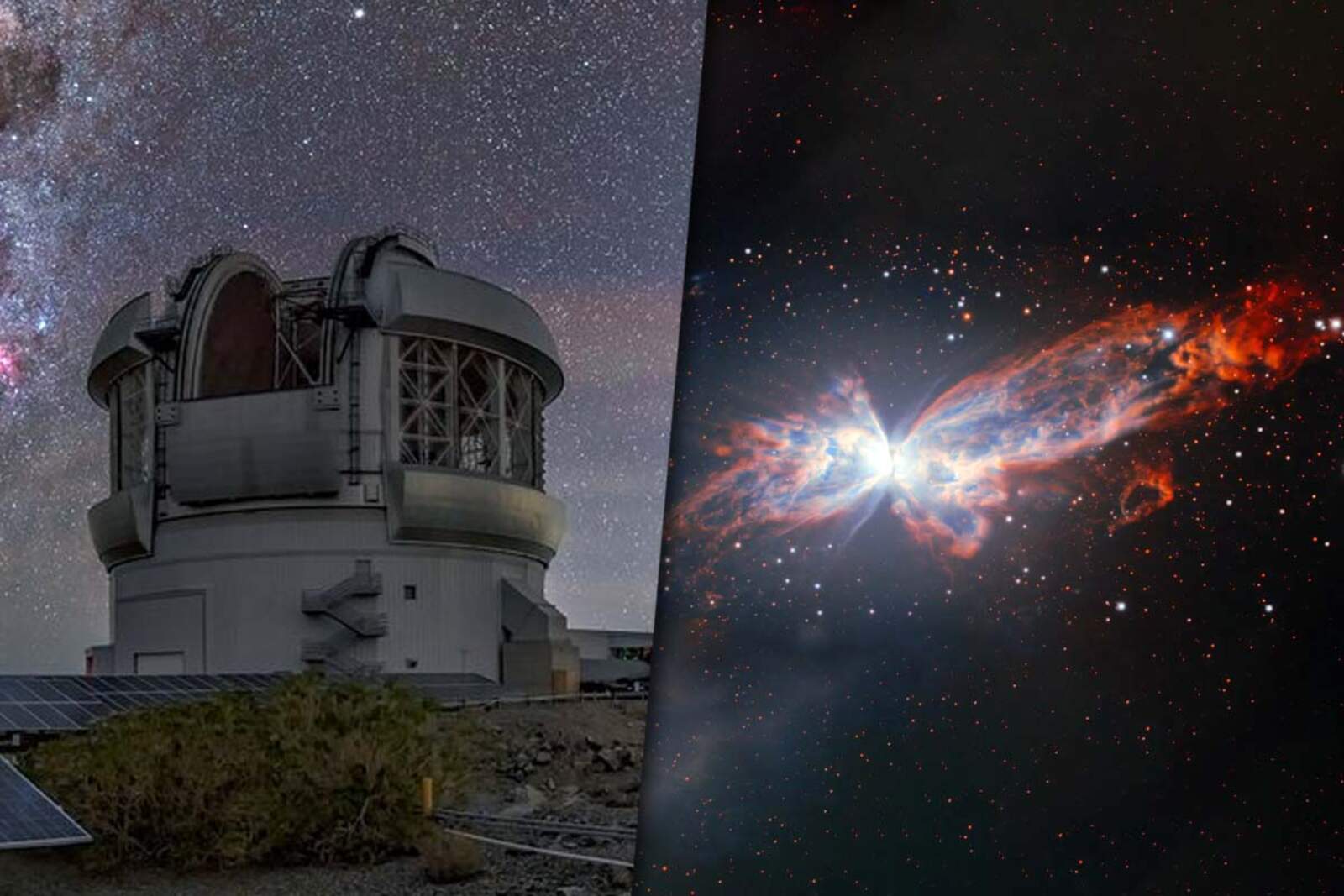

The Gemini South Telescope, located in Chile, captured one of the most striking images of deep space. The well-known Butterfly Nebula (NGC 6302 or Caldwell 69), a bipolar astronomical object located between 2,500 and 3,800 light-years away in the constellation of Scorpius. The photograph was released by the International Gemini Observatory.
The image was selected to celebrate the 25th anniversary of the telescope. The image stands out for the precision with which it shows the turbulent flows of gas surrounding its central star.
A "butterfly" formed by the violent death of a star
The image displays the complexity of NGC 6302, whose shape resembles the open wings of a butterfly. This appearance is the result of a violent process that occurs when a massive star approaches the end of its life cycle.
At the center of this nebula is a white dwarf, the ultra-dense remnant of a star similar to the Sun. It has approximately two-thirds of its mass and is one of the hottest stars known, with a surface temperature exceeding 250,000 °C (482,000 °F).