A recent study by Martín González-Rozada revealed a sharp drop in poverty for the third quarter of 2025
Compartir:
Poverty and extreme poverty registered a sharp drop in Argentina, reaching one of the lowest levels in recent years, thanks to the successful economic plan of the government of Javier Milei.
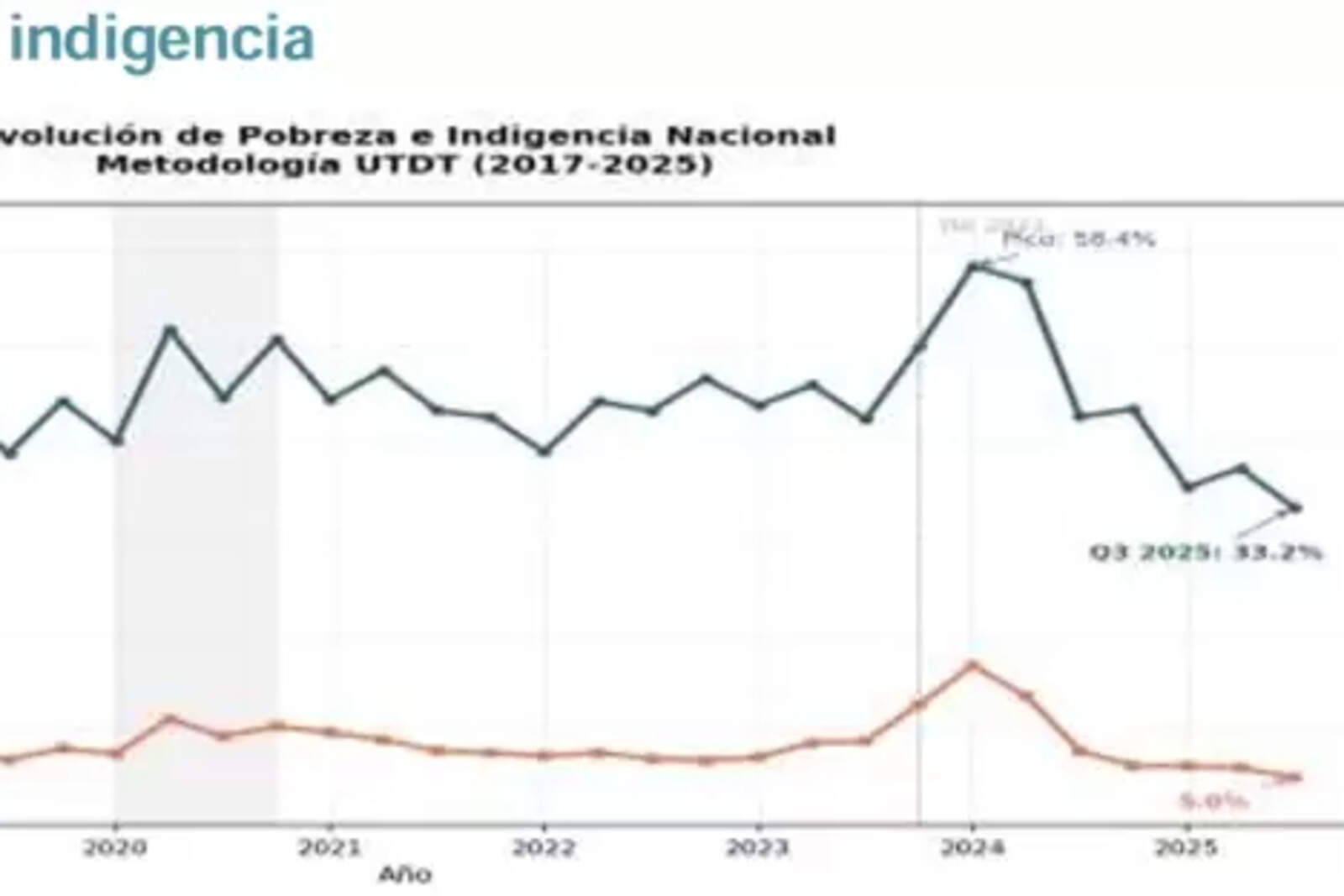
According to the latest report prepared by Martín González-Rozada from the Economics Department of Universidad Torcuato Di Tella (UTDT), the poverty rate stood at 33.2% during the third quarter of 2025, while extreme poverty fell to 5%, the lowest level in a decade.
The figure represents a sustained downward trend over the last quarters and marks a sharp change compared with the critical scenario observed at the beginning of 2024, in the midst of the severe economic crisis inherited from Kirchnerism.
El presidente Javier Milei.
According to the study, poverty fell by 25.2 percentage points compared with the peak recorded in the first quarter of that year, a drop of such magnitude that it has no recent precedent in such a short period of time.
Moreover, between the second and third quarters of 2025, the poverty rate fell by 4.1 percentage points, which confirms that the reduction process did not stall and continues to move forward consistently. In parallel, extreme poverty, which measures the population whose income is not enough to cover a basic food basket, stood at 5%, the lowest value since the third quarter of 2017.
The UTDT report emphasizes that its estimates usually stand above the official figures from Indec, since they are based on a more demanding and updated consumption basket. However, the study itself highlights that both measurements show a correlation of 0.99, which reinforces the robustness of the results and confirms that the decline in poverty doesn't respond to a methodological effect, but to a structural trend.
El informe de Martín González-Rozada.
Another central point of the work is the widespread improvement at the territorial level. The reduction in poverty was observed in all regions of the country, including those that have historically been the most neglected.
In the Northeast of Argentina (NEA) and the Northwest of Argentina (NOA), which continue to show the highest rates, the sharpest drops were recorded. NEA reduced its poverty rate by 9.2 percentage points compared with the previous quarter and stood at 43.8%, while NOA reached 40.7%.
In Greater Buenos Aires, considered the country's main social barometer due to its demographic weight, poverty stood at 33.3%, practically in line with the national average. This figure is especially relevant because it is the region that usually concentrates the greatest impacts of economic crises.
The Pampas and Patagonian regions showed the best indicators. The Pampas region recorded a poverty rate of 28.9%, while Patagonia stood at 26.4%, the lowest incidences in the country according to UTDT's measurement.