A few days before the tenth anniversary of Milagro Sala's arrest, the national government formally requested before the Inter-American Court of Human Rights (IACHR) that the house arrest of the Jujuy leader be brought to an end and that she serve her sentence in a regular penitentiary facility.
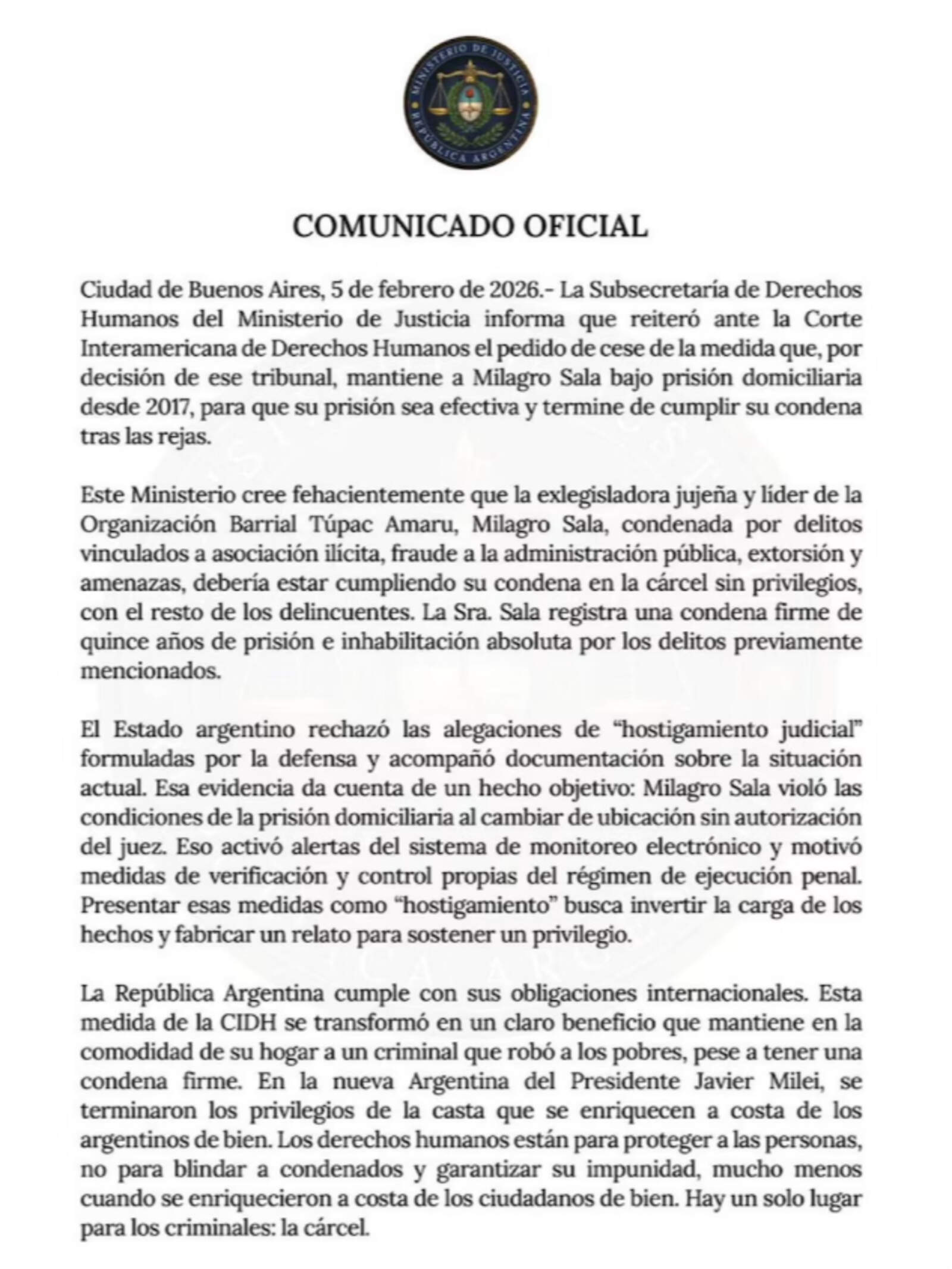
The filing was submitted by the National Undersecretariat for Human Rights, which argued that the exceptional measure ordered in 2017 by the international court turned into an unjustified privilege, even though Sala has a final 15-year prison sentence for serious crimes against public administration.
A final conviction for serious crimes
Milagro Sala, former provincial legislator and leader of the neighborhood organization Tupac Amaru, was convicted of illicit association, fraud against public administration, extortion, and threats, in addition to receiving an absolute disqualification.
The government keeps that house arrest doesn't correspond to the seriousness of the crimes, and it emphasizes that the social leader is no longer in a procedural situation but has a final sentence upheld by the Supreme Court of Justice of the Nation.
Rejection of the "judicial harassment" argument
El Gobierno pidió a la CIDH que Milagro Sala deje la prisión domiciliaria y cumpla su condena en cárcel común
In the filing before the IACHR, the Argentine state rejected the allegations of "judicial harassment" promoted by Sala's defense. According to the official documentation, the leader allegedly violated the conditions of house arrest by changing her address without judicial authorization.
That move triggered alerts in the electronic monitoring system, which led to additional checks by penitentiary authorities. The Ministry of Justice stated that presenting those checks as persecution seeks to uphold a benefit that doesn't apply.
The position of the Ministry of Justice
In an official statement, the National Ministry of Justice, headed by Mariano Cúneo Libarona, stated that: "The Argentine Republic complies with its international obligations, but this measure by the Inter-American Court turned into a clear benefit that keeps in the comfort of her home a criminal who stole from the poor, despite having a final conviction."
The government stressed that honoring international commitments doesn't mean upholding privileges that are incompatible with the rule of law.
The current procedural situation
Sala completed two-thirds of her sentence last month, reaching 10 of the 15 years imposed by the Jujuy judiciary. This entitles her, according to the Penal Code, to request parole, although supervised release can only be considered in 2030 and the sentence will expire in January 2031.
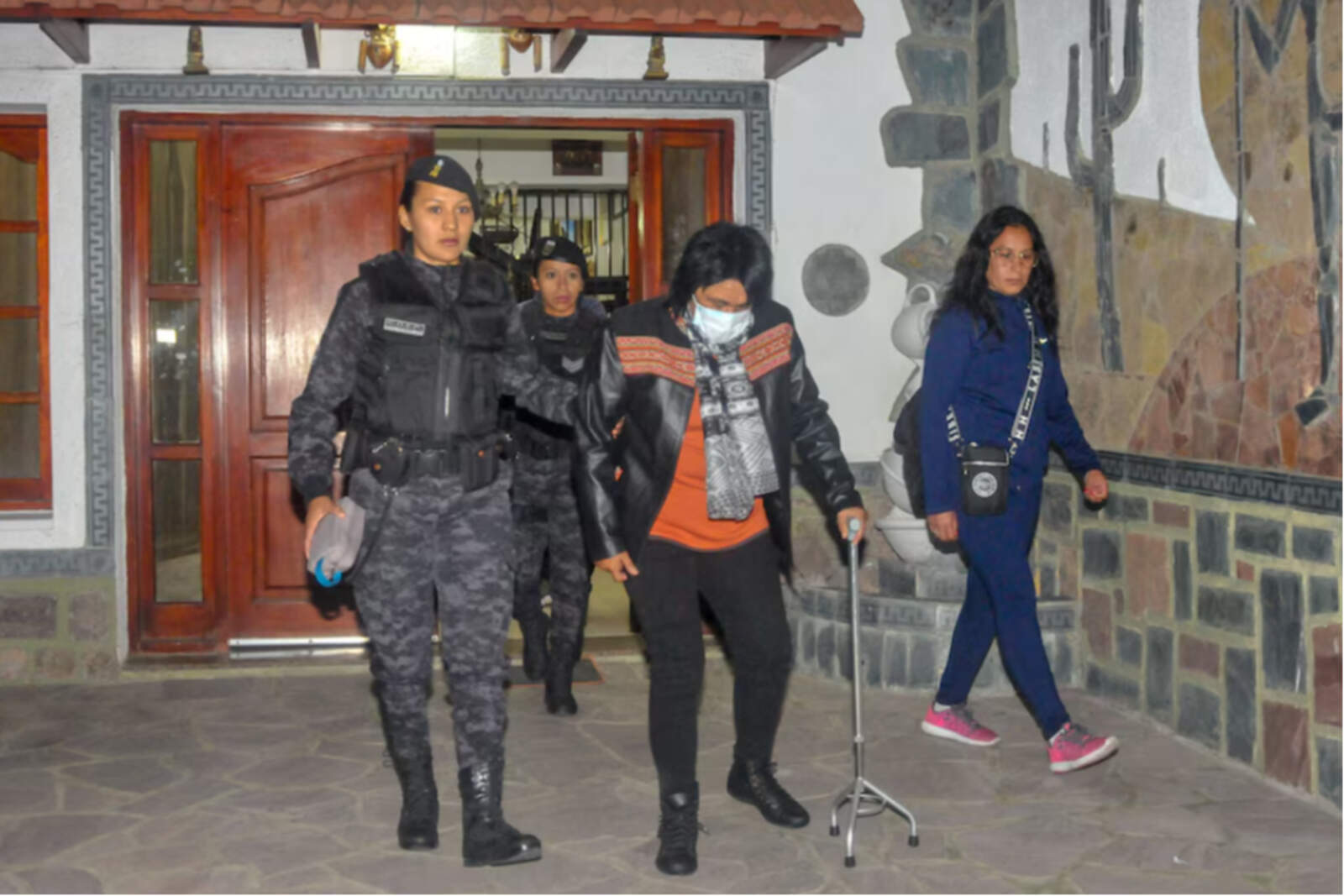
Currently, the leader is hospitalized at the Hospital de Gonnet in La Plata. Her defense has reported alleged irregularities during that hospitalization, criticisms that were dismissed by the ruling party, which insists that these are normal judicial checks.
The court cases that support the conviction
One of the convictions against Sala was for the crime of threats, as a result of calls made in 2014 to a police station in Alto Comedero, where she warned that she would place bombs if seized belongings were not returned. That case resulted in a two-year sentence.
The main case, known as "Pibes Villeros," considered her the head of an illicit association that diverted public funds intended for social housing in Jujuy. Criminal Oral Court 3 sentenced her to 13 years in prison for illicit association, fraud, and extortion.
According to the case file, the fraud against the state amounted to 60 million pesos, corresponding to housing that was never built. The trial began in 2018 and included testimony from more than 100 witnesses.
El Gobierno pidió a la CIDH que Milagro Sala deje la prisión domiciliaria y cumpla su condena en cárcel común
A political and judicial message
The government believes that the request before the IACHR marks a change of era, aimed at ending inherited exceptional regimes and reaffirming that the law must be applied equally, even in cases with a high political component.
The request seeks for Milagro Sala to stop serving her sentence at home and to be transferred to a regular prison, in line with the principle that privileges can't be maintained in the face of final convictions for corruption.