In practice, the effective rates for registered employment may fall to 14.4% or 12%, depending on the sector, which implies a significant reduction in the labor burden.
The bill also creates the Labor Formalization Incentive Regime (RIFL), in force for one year, which establishes a reduced 2% rate in employer contributions during the first 48 months for new hires that imply a net increase in headcount. At the same time, workers who receive social plans won't lose the benefit during the first year of formal employment, boosting the transition to the registered labor market.
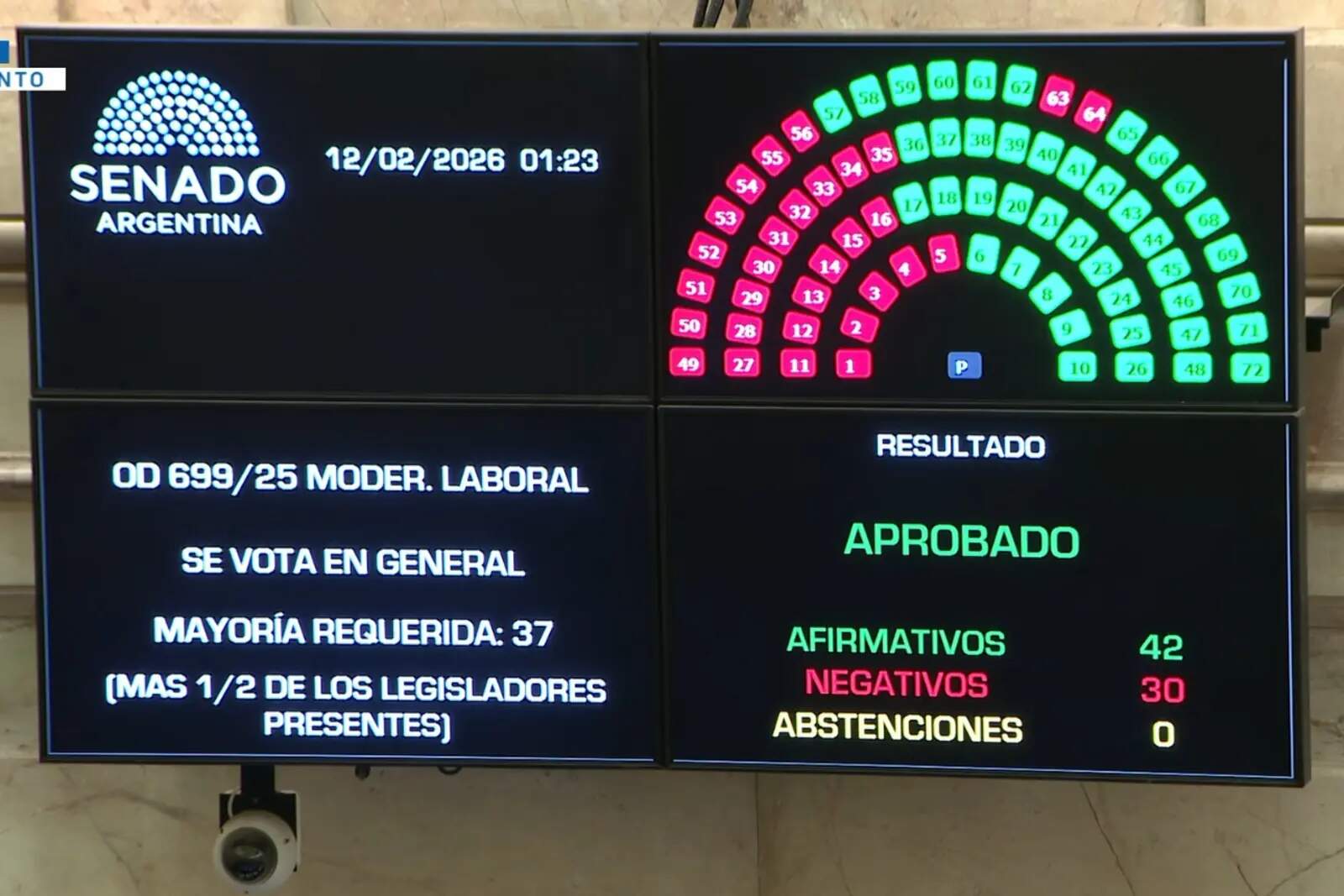
During the early hours of this Thursday, the government of Javier Milei managed to have the labor modernization bill approved in the Senate, an initiative that represents a deep change in the Argentine employment regime.
The bill aims to establish clear and predictable rules, reduce litigation, and create a more dynamic and modern framework for productive development, with the goal of promoting the creation of formal employment and new investments.
Among the central pillars, the amendments to Employment Contract Law 20.744 stand out. The initiative excludes from its application independent workers with collaborators and workers on technological platforms, defining the scope of the regulations with greater precision.
The principle of "most favorable rule for the worker" is also limited to strictly legal matters, and "social justice" is eliminated as an interpretive criterion, which introduces greater predictability and seriousness in the application of the law.
Javier Milei.
In addition, it is clearly established that severance pay for dismissal without cause will be the only applicable remedy, ruling out additional claims for damages, unless there is autonomous damage that is duly proven, seeking to reduce litigation. It also defines what must be understood as "normal and habitual" remuneration, limiting the inclusion of non-monthly items in the severance calculation base.
In terms of labor costs, the reform introduces Labor Assistance Funds (FAL), which will operate as a separate estate intended to guarantee the payment of severance. They will be financed with a monthly contribution of 3% of wages, but at the same time a reduction of employer contribution rates is envisaged.
La votación en el Senado.
The law incorporates numerous tax benefits, reduces domestic taxes, such as those on cellular and satellite phone services, and creates the Incentive Regime for Medium-Sized Investments (RIMI), with accelerated depreciation for Income Tax and early VAT refunds, in a scheme aimed at driving growth, strengthening competitiveness, and promoting formal employment in Argentina.
In relation to collective bargaining agreements, the principle of ultra-activity is amended, limiting the automatic validity of expired clauses. Agreements at a lower level will also prevail over those at a higher level, granting greater flexibility at the sectoral or company level.
The reform also introduces changes in the strike regime in essential services and limits company blockades by classifying them as very serious offenses.
Among other key points, the payment of wages in foreign currency is allowed, vacations may be taken outside the period established by law, as long as a minimum of seven days is respected, a "Basic Labor Training Program" is created within the scope of the Labor Secretariat, and a specific regime is established for services provided through technological platforms.
Finally, the "hours bank" will be implemented, a rule that allows employers and workers to voluntarily agree on a system for compensating overtime hours, provided that the minimum legal rest periods between workdays and weekly rest are respected.