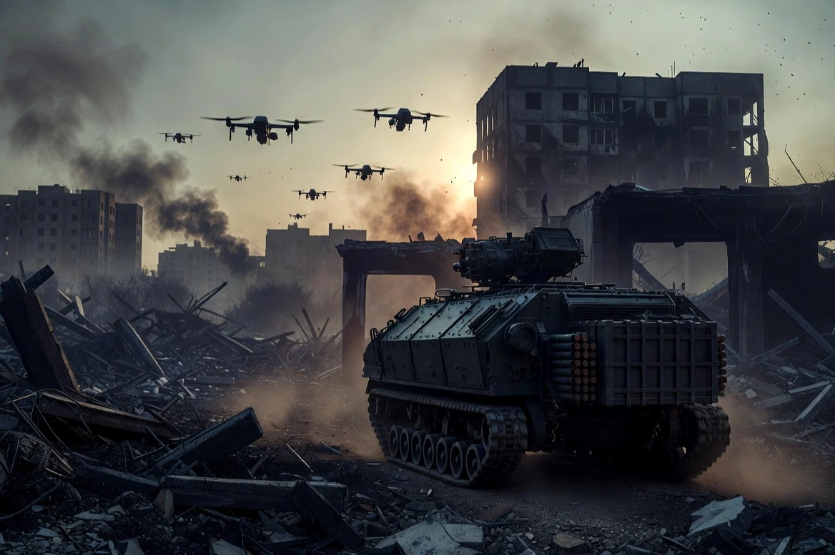
In the midst of the conflict in Ukraine, the armed forces are implementing an innovative tactic to confront Russian positions entrenched in buildings. Instead of risking lives in traditional assaults, they send a ground robot loaded with about 300 kilos of explosives that enters the structure and detonates, destroying the target.
This approach recalls historical experiments like the Polish remote-controlled vehicles during the Warsaw Uprising in 1944, but with much more effective current technology. In Kostiantynivka, for example, an unmanned vehicle entered through the back of a block occupied by Russians and caused an explosion that leveled the place.
The operation was coordinated with other support robots and drones, showing a profound change in the way to combat in urban areas. Clearing an enemy building has always been one of the riskiest missions, with ambushes possible in every room or stairway.
The coordination between machines
The key to this evolution is not just the explosive robot, but how it integrates with aerial drones and reconnaissance systems. The drones provide an overview, locate targets, and monitor routes, while ground vehicles advance close to the ground carrying heavy loads.
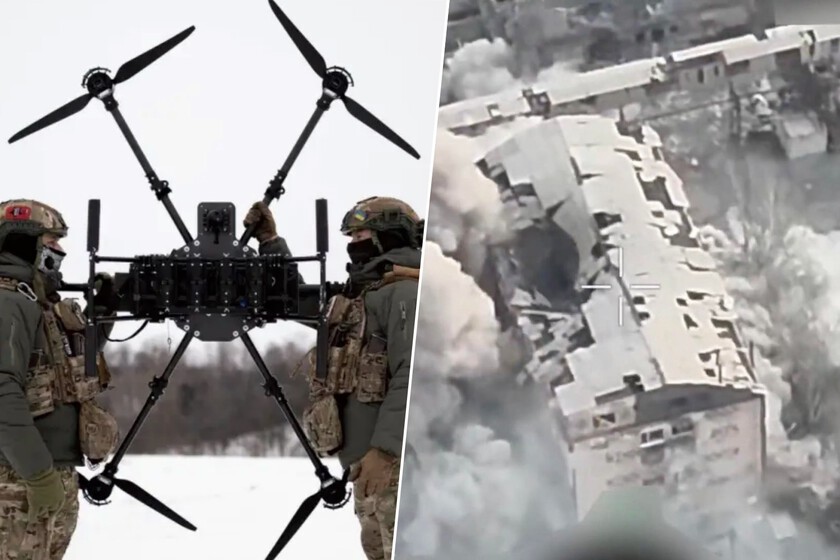
This combination resolves limitations of each system separately. Flying drones are fast but do not carry much weight, whereas wheeled robots can move explosives capable of demolishing basements or opening significant breaches.
In this way, Ukraine seeks to progressively replace dangerous tasks that infantry used to perform. After years of attrition against a larger army, reducing their own casualties has become a strategic priority.
Ground robots, known as UGVs, have transitioned from logistical uses like transporting ammunition or evacuating the wounded to direct offensive roles. President Zelensky requested tens of thousands of these vehicles for this year, aiming to automate part of the front logistics.
The psychological and operational impact
In parallel, aerial drones like the Vampire generate fear among Russian troops. Their nighttime sound has become a tool of psychological terror, and they have demonstrated the ability to rescue captured soldiers using thermal cameras and precise strikes.
These cheap and flexible platforms can launch mines, transport supplies, and withstand some interference. Russian soldiers now face threats coming from the air, seemingly empty windows, or streets.
The war in Ukraine accelerates a transformation that other armies will analyze for years. What seemed like science fiction, such as a robot loaded with explosives entering a fortified building, is already part of real operations in Donbas.
Although they still lose many robots to Russian drones, destroying machines proves more sustainable than losing experienced soldiers. Urban warfare is evolving into a battlefield saturated with autonomous systems where the first to contact the enemy are remotely controlled machines.
This trend marks a turning point in modern combat, prioritizing technology to minimize human cost in a high-intensity conflict.