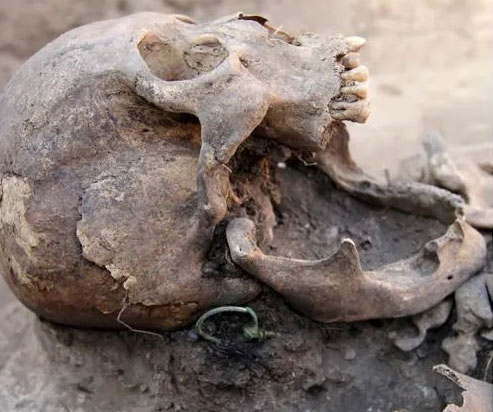

In the Sayan Mountains of southern Siberia, an archaeological finding from 2014 uncovered an unusual burial from the 10th century. During preliminary work for the construction of a railway, dozens of graves were discovered, but this particular one caught the attention of researchers due to its unusual contents.
The remains belonged to a woman and a newborn, accompanied by the spine of a sheep and the skull, limbs, and skin of a horse. “It is quite clear that this is not an ordinary burial,” noted Andrey Poliakov from the Russian Academy of Sciences.
The woman was buried with a pair of gilded bronze earrings, a ritually broken mirror, an iron knife, and a stone mortar. The motif of a twisted vine with clusters of grapes on the fragments of the mirror suggests that the object may have been imported from China.
Equine elements with distant influences
Among the most notable artifacts are pieces of horse harnesses that were already antiques at the time of the burial. A stirrup, for example, featured decorations influenced by Chinese, Indian, and Persian art. According to Oleg Mitko from Novosibirsk State University, decorated stirrups were generally used by nomads of the steppes on the left side of the saddle for ceremonial purposes.
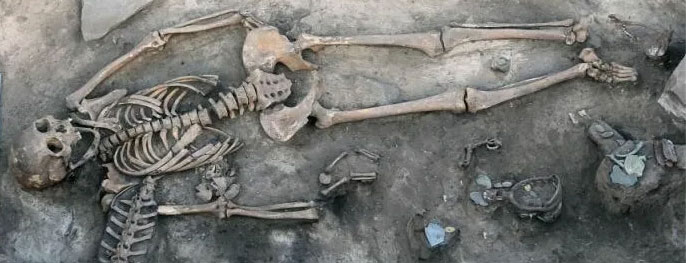
This combination of objects is very rare in the region. The presence of imported and reused elements speaks to the broad cultural connections that the inhabitants of the area maintained over a thousand years ago.