On Tuesday, August 12, a group of students from the Instituto de Profesores Artigas did something that in the culture of the institute amounts to an act of courage: they stood in front of the cameras to say that they do not agree with the occupation that the communist unions —both student and teacher, aligned with the CSEU-PIT-CNT— have maintained since July 23. Their position, reported by Subrayado, was of almost surgical moderation: they did not question the reasons for the conflict, but the method. “We are against the way they protest,” they explained: the occupation was the first measure taken, not the last, without exhausting any other avenue first.
One of those who stepped forward was Lucía Cabrera. The machinery ensured that she would regret it.
How the apparatus works
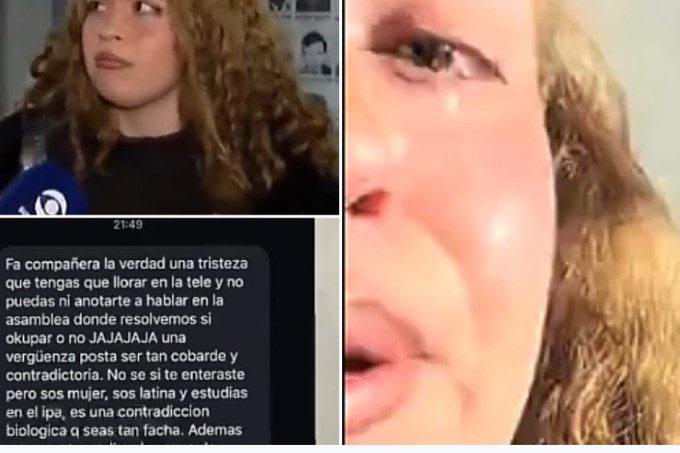
Days after her appearance in the media, Cabrera recorded a video crying in which she stated that she would have to stop studying due to the number of harassment messages received in a matter of hours. Her question, through tears, is one that should be echoing in Codicen, in Parliament, and in every teachers' room in the country: “I think we are in a democracy, we have freedom of expression… For expressing that I am against it, do they have to tell me that I am a fascist?”
Let’s review the mechanics of the punishment, because it is textbook. First, the marking: photos of Cabrera circulating in the WhatsApp group of her own class —among her classmates, future teachers of all Uruguayans' children— with the accusation of “fascist.” Second, the swarm: the avalanche of hostile messages in a matter of hours, spread by the student herself. Third, the desired outcome: the young woman leaves the group, leaves the career, leaves the public space. No one signed an order. No one needed to sign it. This is how ideological discipline works in spaces that the union left has controlled for decades: a political commissar is not needed when the militancy does the dirty work in chain.
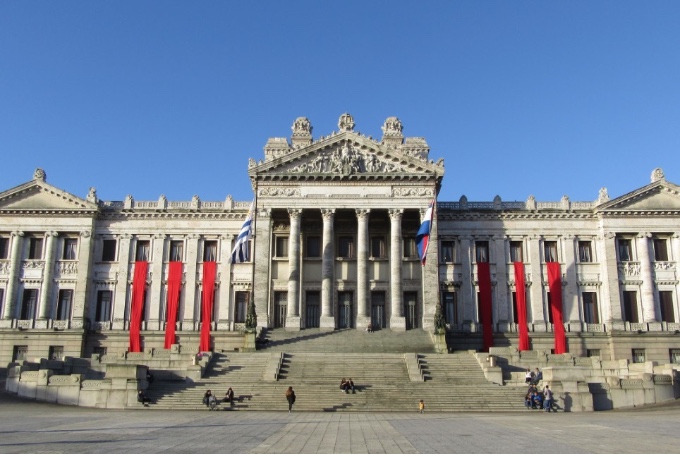
Cabrera did the only thing left for her: she called Codicen, recorded the conversation, and made it public. The agency assured her that “the corresponding investigations” would be conducted. We take note of the promise. And we also take note that the case only reached the national agenda when La Derecha Diario Uruguay spread it on social media and the political class could no longer look the other way: nationalist senator Sebastián Da Silva shared the complaint with a statement that needs no translation: “They are fascists. They are fascists.”
The senator is right in essence, although the exact label matters less than the behavior: persecuting those who think differently until they are expelled from a public institution is the operational definition of all totalitarianism, regardless of its color. And here the color is well known.
Hypocrisy as a method
To gauge the cynicism of the unions that today harass Cabrera, it is worth recalling what they understand by “censorship” and “persecution.” In August 2022, when the authorities of the ANEP covered the graffiti that the union had made on the façade of the IPA, Ceipa issued an indignant statement: covering a wall was “censorship,” part of a “persecution program” against colleagues “for carrying out their union activity.”
Read it again. Painting over a graffiti: intolerable censorship. Harassing a classmate with photos and chain messages until she abandons her studies: absolute silence. Not a statement, not a self-criticism, not a word. For the union apparatus, freedom of expression is a monopoly: theirs is protected even on others' walls; Cabrera's ends where the discomfort of the assembly begins.
This is not an isolated case: it is the operating system of the IPA
Anyone familiar with the IPA knows that the Cabrera case is not an anomaly but the visible version of an internal regime that has been denounced for years. In 2022, during the occupations against the educational reform of the previous government, nearly 200 students organized to oppose the measure voted by Ceipa, which had cost 29 days of lost classes. Those students described to Teledoce a climate that today sounds prophetic: the atmosphere inside the IPA for those opposing the occupation “has become hostile.” Students with nearly excellent grades who abandoned partial exams; classmates who decided to retake the entire year. That is the real academic cost that the assembly never accounts for.
The arithmetic of institutional kidnapping is equally eloquent. One of the historical occupations of the IPA was voted 138 in favor, 26 against, and 3 abstentions: fewer than 170 voters deciding for an institute with more than 4,600 enrolled. 96% of the student body does not participate in the assembly that closes the institute, makes them lose the semester, and mortgages their career. And if anyone from that 96% dares to say it in front of a camera, they already know what awaits them: ask Lucía Cabrera.
The pattern repeats with any government: occupations in 2018, 2022, 2023, 2024, and 2026. The pretext changes —Da Silveira's reform yesterday, Caggiani's “cardboard degrees” today— but the method is invariable: to close down, sacrifice the class days of all, and manage dissent through fear. In 2022, it took the police to evict the centers for classes to resume; the legislators of the Frente Amplio, instead of supporting the thousands of hostage students, showed up at the occupied centers to give “guarantees” to the occupiers. The chain of political protection of the apparatus works at full capacity: the union occupies, the party shields it, and the student who wants to study has no one.
The detail that aggravates everything
All of this occurs in the institute that trains the country's secondary school teachers. The same union spaces that claim to defend public education against its “devaluation” practice, behind closed doors, the exact denial of what a teacher should convey in a classroom: pluralism, debate, tolerance for dissent. The question is as uncomfortable as it is inevitable: what will the graduates of an institution whose internal culture consists of targeting the classmate who disagrees until she leaves teach about democracy and coexistence? The apparatus is not only destroying the career of a student: it is serially manufacturing the authoritarian culture that then spills over into high schools across the country.
What needs to happen now
Codicen promised to investigate. Let them investigate, with names, deadlines, and public consequences. But let no one be fooled: the problem does not end with a file. What is at stake is whether the Uruguayan state tolerates that, within its own institutions, a political-union apparatus exercises the monopoly of fear. Three minimum things are imposed:
First, effective and visible protection for Cabrera and for any student who reports: if she ends up outside the IPA and her harassers inside, the message for the thousands who think like her will be that they were right to remain silent. Second, the regulation of occupations in teacher training: an assembly of 150 militants cannot indefinitely close the rights of 4,600 students; the right to protest of some ends where the right to study of all begins. Third, calling things by their name: this is not “student internal affairs” nor “conflict climate.” It is ideological persecution within a public institution funded by all Uruguayans, executed by a union apparatus that responds to a political project, and protected by the complicit silence of those who should guarantee the freedom of all.
Lucía Cabrera asked the right question: for expressing an opposing opinion, do you have to accept being called a “fascist” until you abandon your studies? All of Uruguay has the obligation to respond to her. And the answer cannot be another statement: it must be the end of the impunity of the apparatus.