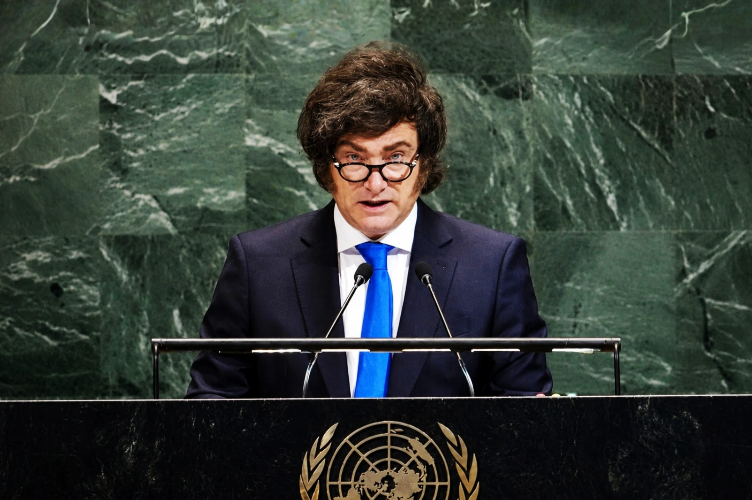

Argentina has left behind a foreign policy that lacked direction and character. Today, it has returned to acting in the world as a Nation that knows who it is, what it defends, and where it wants to go. Under the government of President Javier Milei, the country's international positioning is not improvised, nor is it adjusted according to the convenience of the day or negotiated in the shadows. It arises from a vision clearly articulated during the presidential campaign and is executed today with pragmatism, coherence, and conviction.
The President stated it when he was a candidate and maintained it later in the main international forums. Argentina had to stand on clear principles again. Freedom, life, private property, trade, defense of the West, national sovereignty, and rejection of any international bureaucracy that seeks to place itself above States to impose a certain way of living on the citizens of the world. That was the announced course. That is the course we are currently pursuing.
This coherence surprises many. For years, the world heard Argentine politics promise one thing and do another. In this phase, the opposite occurs. We do exactly what we said we would do. That phrase, so simple, has enormous political power. In an international system saturated with ambiguity, predictability becomes power.
The Foreign Ministry has a concrete responsibility. To transform the President's vision into international action. To turn principles into alliances, alliances into agreements, agreements into opportunities, and opportunities into investment, exports, and employment. Foreign policy does not float above national reality. It is the external mirror of an Argentina that organizes its economy, regains moral authority, and looks to the future with ambition.
Alliances without ambiguity
President Milei defined a clear strategic orientation from day one. Argentina had to strengthen its relationship with the United States and Israel. Not for transient affinities or diplomatic speculation, but as an expression of a deep convergence of values, interests, and a shared understanding of the world.
With the United States, there is an evident complementarity. Argentina possesses strategic resources, energy, food, critical minerals, talent, and productive capacity. The United States has capital, technology, financing, scale, and a hemispheric perspective that increasingly makes the security of supply chains relevant. That relationship is already advancing with concrete instruments.
The Reciprocal Trade and Investment Agreement, the memorandum on critical minerals, the work with EXIM Bank and DFC, and Argentina's participation in the Shield of the Americas and the Peace Board demonstrate a relationship with political, economic, and strategic density.
The same is true with Israel. We share innovation, security, technology, and the defense of free societies against terrorism. We also share a moral conviction. Argentina knows firsthand the cost of international terrorism. It suffered it at the Israeli Embassy and at AMIA. It felt it again on October 7, when Argentine citizens were murdered and kidnapped by Hamas.
That is why our position admits no nuances. Argentina has declared the Islamic Revolutionary Guard, the Quds Force, Hezbollah, and Hamas as terrorist organizations, with their registration in the Public Registry of Persons and Entities Linked to Acts of Terrorism and their Financing. It also declared the Iranian chargé d'affaires persona non grata. In the face of terrorism, our country has stopped dwelling in the comfort of gray areas. It has taken a stand. And taking a stand, in these times, also builds prestige.
That same decision is expressed in Argentina's presidency of the International Alliance for Holocaust Remembrance. We did not assume that responsibility to occupy a symbolic place, but to promote an active policy against anti-Semitism, the trivialization of hatred, and indifference to terror. Argentina wants to lead in Latin America an agenda of memory, education, and defense of historical truth. A nation that knows how to identify horror also knows how to defend the future.
Regional leadership through example
The new international orientation also has a regional impact. Leading does not mean giving lessons from a pulpit. It means showing a path through actions. It means organizing the economy, defending principles, strengthening alliances, and acting clearly against dictatorships, terrorism, and threats to freedom.
Argentina does not remain silent in the face of regimes that violate rights, persecute citizens, and turn the State into an instrument of oppression. Our voice in the region is supported by a simple conviction. Freedom cannot be defended half-heartedly. That is why we clearly condemn the Venezuelan dictatorship and support actions aimed at holding Nicolás Maduro accountable for the crimes and systematic violations committed by his regime.
In this sense, the strategic relationship with the United States and Israel reinforces a clearer, firmer, and more consistent hemispheric position. Argentina has decided to abandon ambiguity in the face of authoritarianism and to exercise leadership again from moral clarity, political coherence, and active defense of freedom.
This positioning also strengthens our ability to build trust and regional cooperation on new bases. In a continent that has for too long normalized ambiguity in the face of authoritarianism, Argentina has decided to regain conceptual clarity and strategic direction. That definition does not isolate us.










