
This figure represents only a fraction of the resources allocated to gender policies, raising questions about the provincial Kirchnerist government's spending priorities.






The Kirchnerist governor owes billions of pesos to numerous hospitals, including Garrahan
This figure represents only a fraction of the resources allocated to gender policies, raising questions about the provincial Kirchnerist government's spending priorities.





The ultra-Kirchnerist governor of Buenos Aires province, Axel Kicillof, continues to receive criticism for his administration's disastrous budget management, which has sparked a heated public and political debate.
While his government will allocate during 2025 more than $1,425,944 million to programs and structures linked to so-called "gender policies", the Buenos Aires public health system is facing a critical situation due to debts accumulated with reference hospitals.
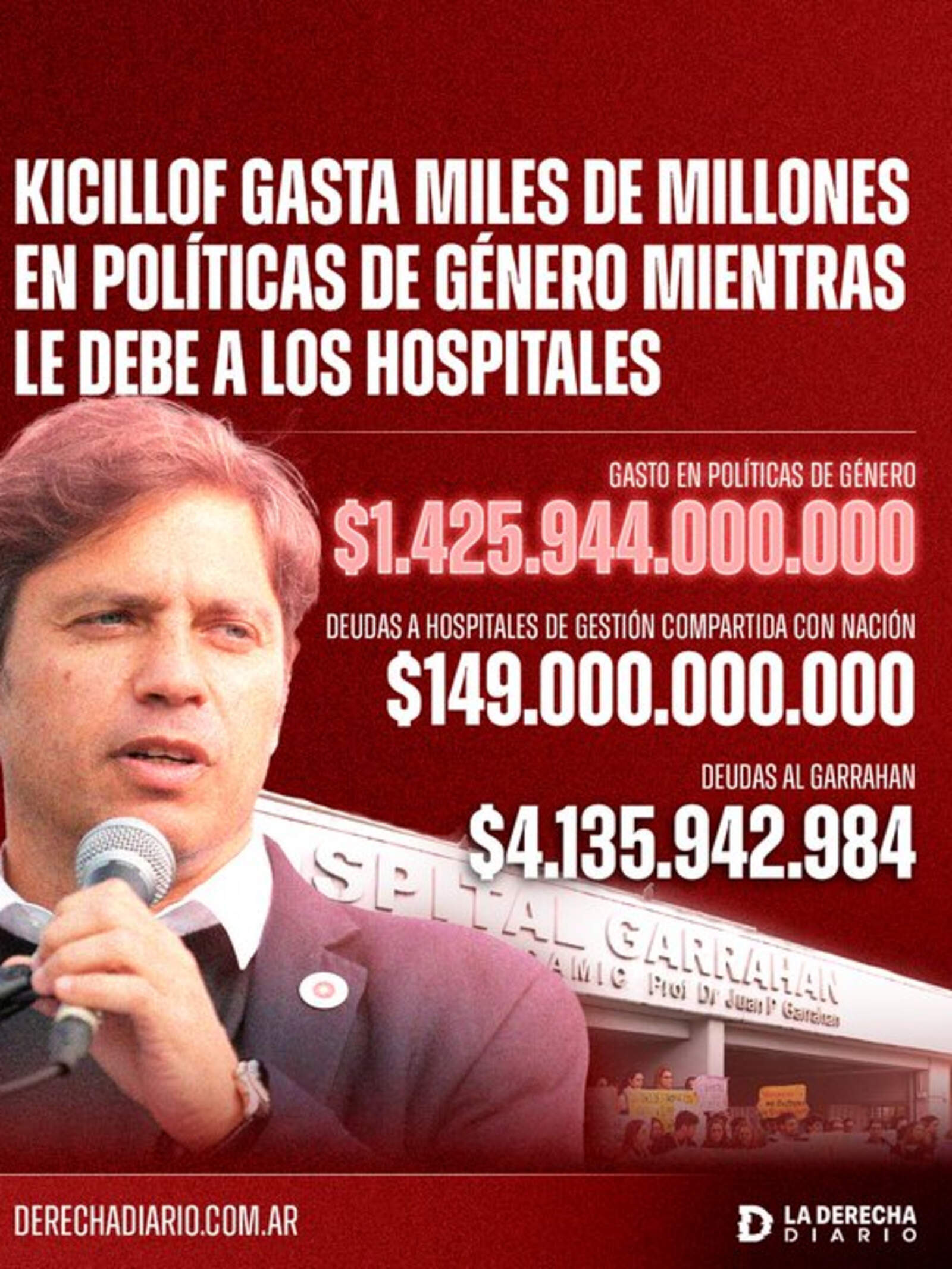
Among the most urgent claims, the debt with the Garrahan Pediatric Hospital stands out, one of the most important health centers in Latin America. According to official information, the Instituto de Obra Médico Asistencial (IOMA), administered by the province, keeps a debt of $4,135 million with the hospital.
The controversy deepens when considering that Garrahan is not the only affected institution. Another five hospitals under joint management between the Nation and the Province, located in areas with high healthcare demand such as Cañuelas, La Matanza, Florencio Varela, and Esteban Echeverría, have accumulated liabilities totaling $149,000 million.

These debts affect the operational capacity of the health centers, which depend on state funding to guarantee care for critical patients and pediatric and hospital specialization programs.
The contrast between the debt with hospitals and the resources allocated to ideological programs is strongly criticized by various political and social sectors, since with just a tenth of the funds allocated to gender policies, the province could settle outstanding obligations with medical institutions, thus avoiding delays in payments to suppliers, medical staff salaries, and the acquisition of essential supplies.