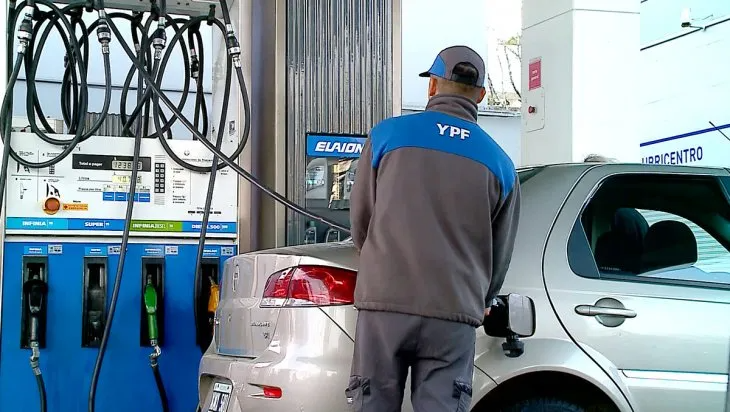
In the midst of the international volatility of the price of oil, the value of fuel in Argentina does not only respond to external factors or decisions of the national government. In parallel, municipalities have incorporated their own burden that directly impacts the final price: so-called road taxes.
These surcharges, applied at the local level, generate specific differences between districts and have become an increasingly important component of the price structure. Depending on the municipality, the rate may be applied as a percentage of the value of the fuel or as a fixed amount per liter sold.
The price of fuel is also comprised of municipal taxes.
In some regions of the country, municipal pressure reaches particularly high levels. In the province of Neuquén, for example, several municipalities apply rates close to 4.5% on the price of each liter, ranking among the highest levels in the country. Added to this are cases in Rio Negro and Jujuy with
similar schemes.
The phenomenon is also replicated in the province of Buenos Aires, where different municipalities have adopted road taxes with relevant rates. Districts such as General Pueyrredón, Pinamar or Colón apply surcharges of around 3%, while others such as Pilar, Moreno or Azul are slightly lower, around 2.5%
.
In turn, there is a large group of municipalities in Buenos Airesgoverned by Kirchnerism —including Avellaneda, Lanús, Lomas de Zamora or Quilmes— that apply rates close to 2%, consolidating a generalized additional burden on fuel in geographical areas where the population is particularly vulnerable.
Axel Kicillof with José C. Paz's former mayor and boss, Mario Ishii. Another scheme used is that of fixed amounts per liter, which also has a direct impact on the final price.
Municipalities such as José C. Paz or General Rodríguez adopted this system, establishing specific surcharges for each liter sold, regardless of the value of the fuel; completely ignoring the economic reality
of their inhabitants.
The opposite of this scheme are municipalities that do not apply road taxes, such as Vicente López or Bahía Blanca. In these districts, the final price is lower, which even generates movements of consumers who move to fill up fuel at a lower cost
.
The local brake on economic relief
This scheme of fiscal pressure at the local level is not an isolated phenomenon that attacks only the price of fuel. In different municipalities in the Buenos Aires suburbs, the authorities have advanced in recent months with new taxes or rate increases that end up being transferred directly to the prices paid by the
neighbors.
A paradigmatic case is that of Pilar, where Federico Achával's management implemented a 2% rate on supermarket operations, automatically increasing the cost of food. The logic is similar to that of road taxes: a surcharge that, in practice, is not absorbed by companies but by the
final consumer. Federico Achaval with the conviction of Cristina Fernández de Kirchner.
This type of measure reveals an increasingly obvious contradiction between the economic direction of the national government and the fiscal policies of many municipalities. While Javier Milei's administration is making progress in reducing distortive taxes, deregulation and improving purchasing power, at the local level, the mechanisms that add pressure on consumers are multiplying
.
Many mayors choose to sustain or even expand collection schemes that directly impact the cost of living. The result is a fragmented dynamic, where efforts to stabilize the economy and recover real income are partially neutralized by additional burdens at the
municipal level.
While the national government is making progress in normalizing the macroeconomy and ending the inflationary process, many mayors insist on increasing rates that make consumption more expensive and end up affecting the quality of life of Argentinians.