October 26, 2025 will be marked in Argentina's electoral history as the day when the citizenry consolidated its decision to abandon the model of decline. Javier Milei's government, despite the severity of the economic adjustment, secured strong support at the polls and won the national legislative elections, capitalizing on the discontent against the populist model.
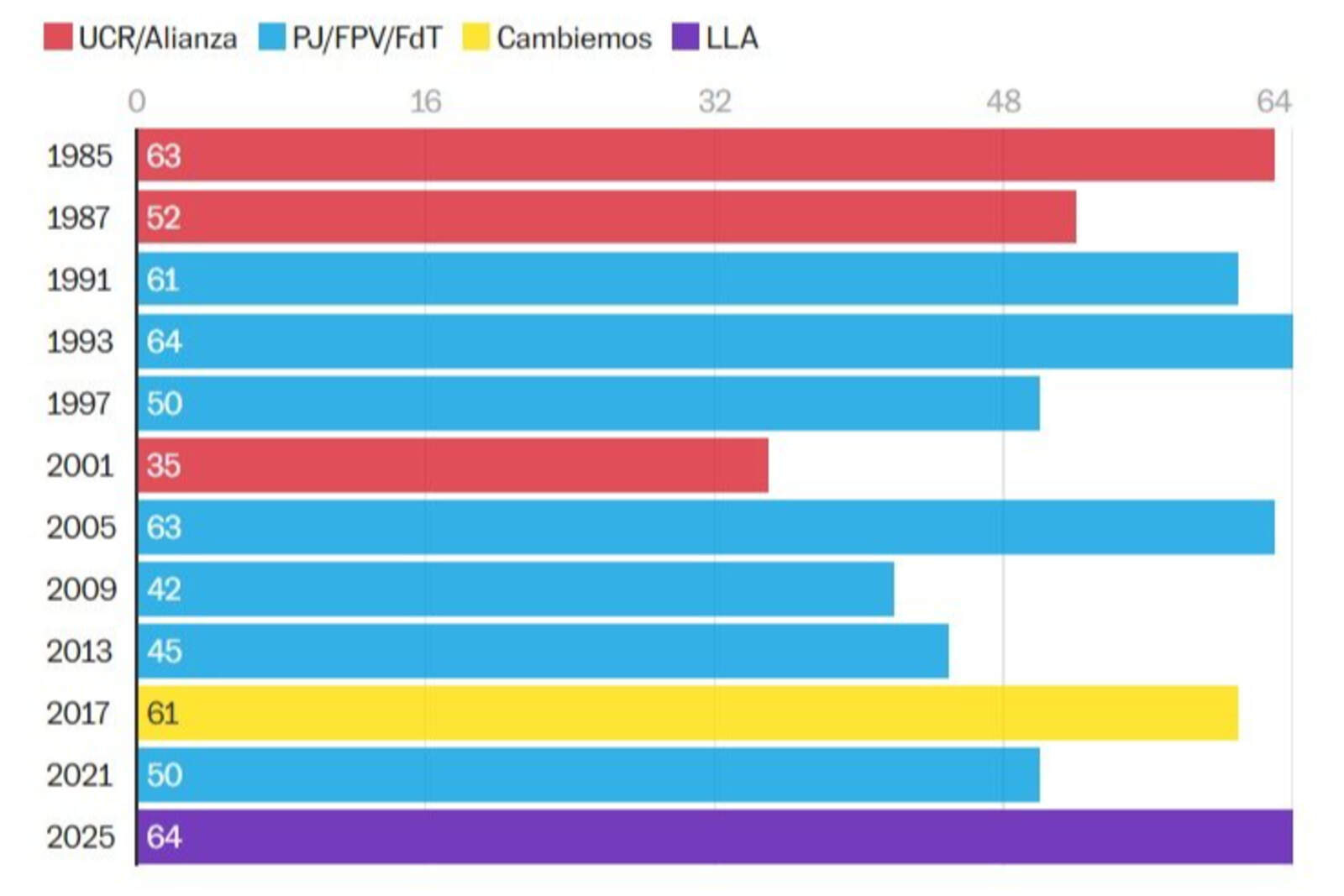
With more than 99% of polling stations counted, La Libertad Avanza (LLA) secured 40.66% of the votes in the election for the Chamber of Deputies. This percentage is not just another number: it represents one of the highest marks recorded by an incumbent in midterm legislative elections since the return of democracy in 1983. Historically, only the 1993 victory, which secured 64 seats and consolidated Carlos Menem's power, and the initial 46% obtained by the Unión Cívica Radical (UCR) in 1985, showed a comparable or superior performance.
Escaño obtenidos por el partido en el gobierno en las elecciones de medio término desde el regreso de la democracia en 1983.
Milei's result is, therefore, the second-best election for an incumbent in 40 years, an achievement that surpasses all administrations in the 21st century.
The victory far exceeds the President's goal of achieving the legislative third that would allow him to shield his decisions. In contrast, the populist opposition, running under the banner of Fuerza Patria and provincial variants, was left at a distant 31.7 percent, confirming the presidential thesis: "One clear fact is that two out of three Argentines do not want to return to the past."
LLA's dominance extended to 16 provinces, showing the penetration of the message of freedom in the productive interior: In Córdoba, Gonzalo Roca led by more than 10 points over former governor Juan Schiaretti. In Santa Fe, Agustín Pellegrini surpassed 40%. In Mendoza and Entre Ríos, LLA exceeded or approached 50 points.
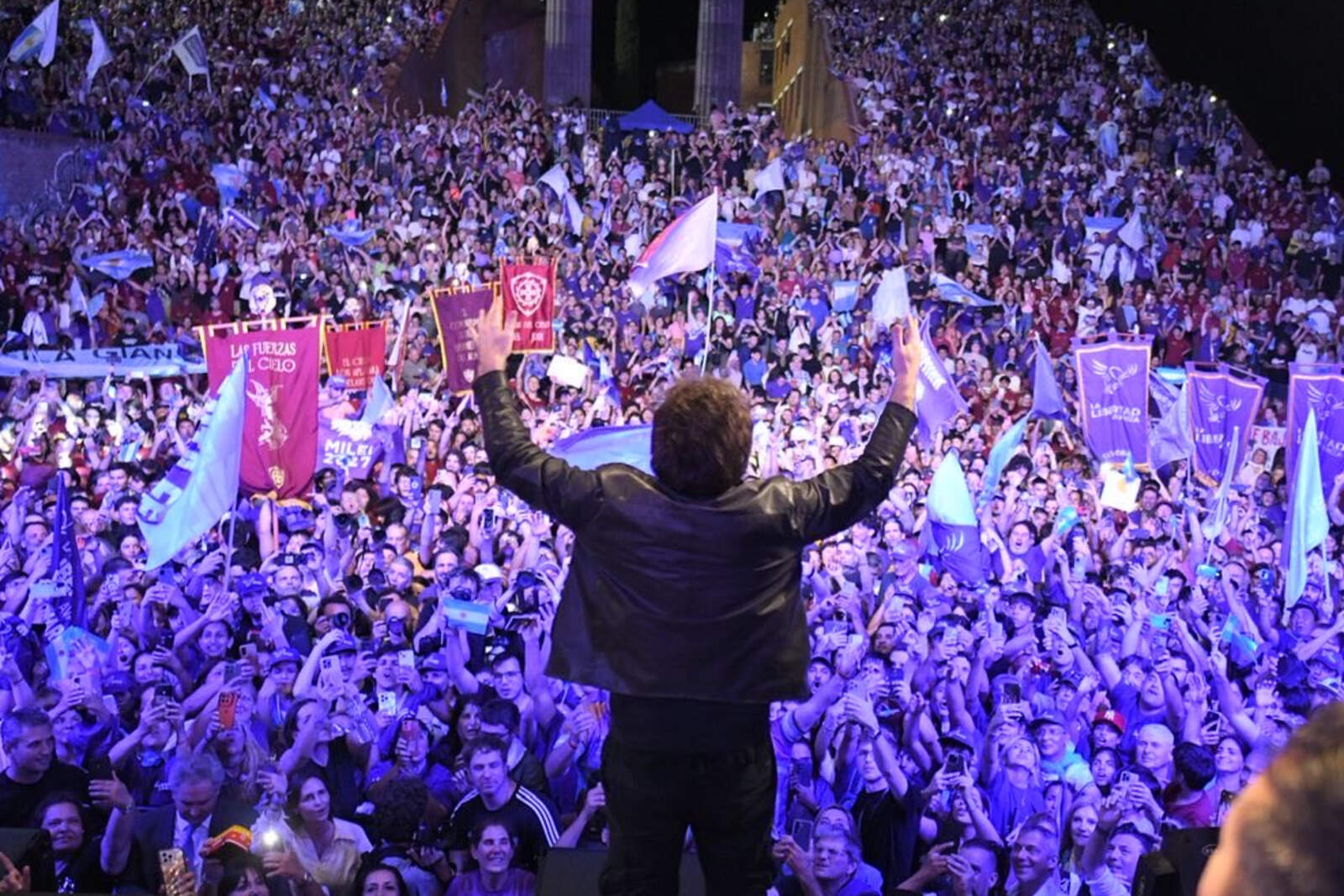
Javier Milei en Rosario.
In Buenos Aires City, Patricia Bullrich had an excellent election for the Senate, garnering more than 50% of the votes and comfortably surpassing the votes obtained by LLA and PRO when running separately in May.
The most significant feat, and the turning point for populism, took place in the Province of Buenos Aires (PBA). This district, which less than two months ago had punished the incumbent with a defeat of more than 14 points, was recovered in an unprecedented act of political will.
The list headed by Diego Santilli (LLA/Allies) secured 41.45% of the votes, narrowly defeating Peronism, which fell to 40.91%. The reversal of a 14-point difference in 45 days is a strong dose of oxygen for La Libertad Avanza and a coup de grâce to the Kirchnerist apparatus.
The impact of the polls translated into unbreakable legislative strength for the President, who will begin the second stage of his term with greater support in Congress.
LLA gained 64 seats and, together with its allies such as PRO, will have 93 seats of its own as of December 10, ensuring control of more than a third of Congress and the ability to sustain presidential vetoes. The opposition's blocking capacity has been neutralized.
In the Senate, the government made significant progress, winning in 6 of the 8 provinces electing senators (CABA, Chaco, Entre Ríos, Neuquén, Santa Fe, and Tierra del Fuego). With 20 representatives in the upper chamber, Peronist hegemony is reduced (which will retain 28 seats), achieving a balance of power vital for structural reforms.
The President, in his speech, anticipated that Argentina will have the "most reformist Congress in its history" and called on governors and legislators from other parties to reach agreements. The victory allows him to reorganize his Cabinet with greater peace of mind, confirming figures such as Guillermo Francos and thanking Manuel Adorni, Diego Santilli, Patricia Bullrich, Karina Milei, and Santiago Caputo, and even the resigned Gerardo Werthein and Mariano Cúneo Libarona.