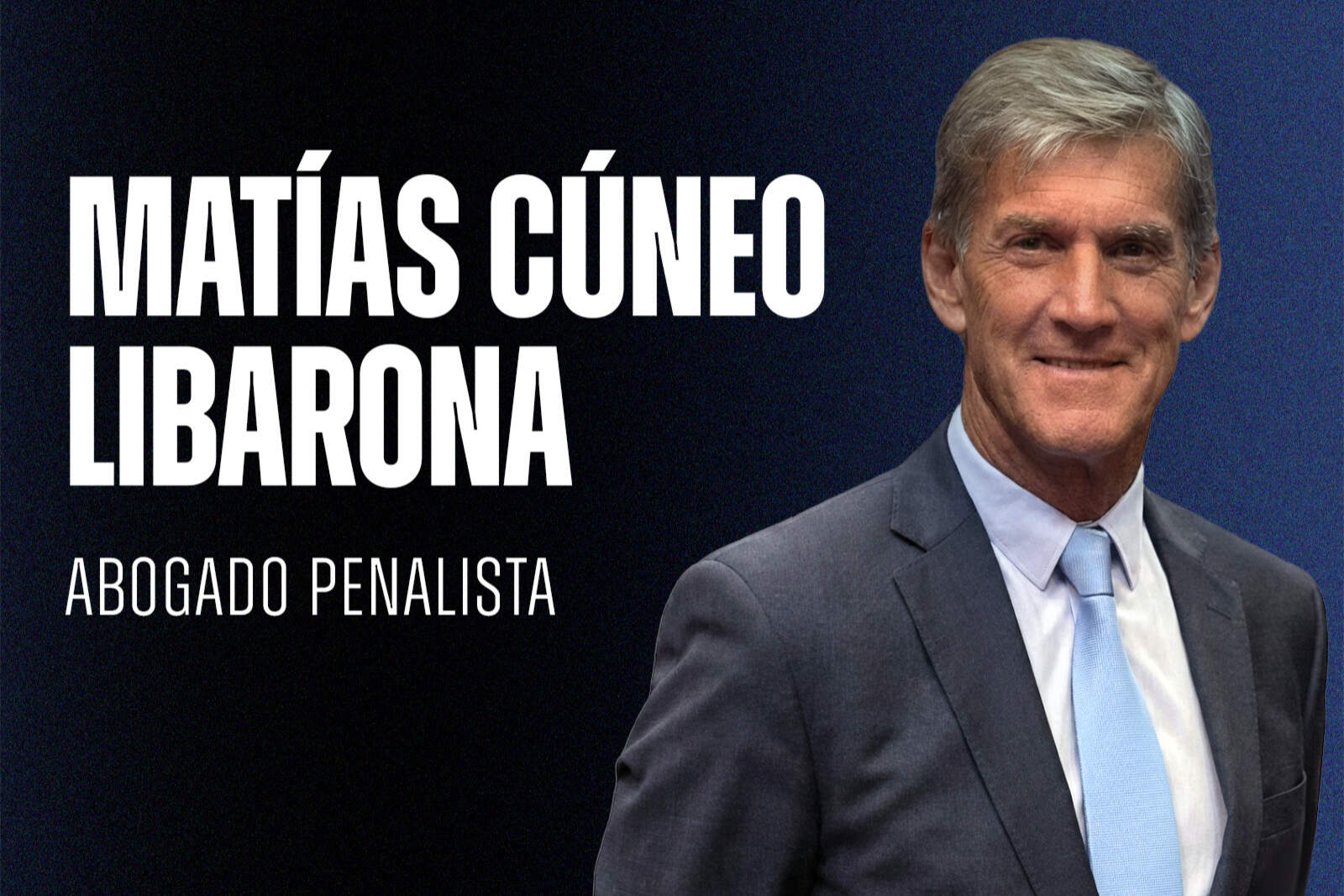

Matías Cúneo Libarona on the reduction in the age of criminal responsibility: 'In 2026, a 13-year-old person knows what they are doing'

Matías Cúneo Libarona on the reduction in the age of criminal responsibility: 'In 2026, a 13-year-old person knows what they are doing'
Matías Cúneo Libarona on the lowering of the age of criminal responsibility: "In 2026, a 13-year-old person knows what they are doing"
porEditorial Team
Argentina

The renowned criminal lawyer analyzed the Jeremías Monzón case and argued that juvenile impunity requires lowering the age of criminal responsibility

Compartir:

Matías Cúneo Libarona is one of the most experienced and respected criminal lawyers in the country, although his name rarely appears on the media agenda. A specialist in criminal law, economic criminal law, customs, tax, and banking law, he has devoted himself for decades to handling extremely complex cases, with an obsessive working method and a surgical eye on judicial and police procedures. Those who know him describe him as relentless, meticulous, and low-profile, an unusual combination in the world of Argentine criminal law.

Trained for years in the national criminal courts, it is well known in judicial corridors that he has as clients key figures such as the Minister of Economy, Luis "Toto" Caputo; the president of the Central Bank, Santiago Bausili; the prestigious physician and scientist Fernando Polack, who is responsible for the development of Pfizer's COVID-19 vaccine; Lionel Messi and his father Jorge; and journalist Javier Negre. He is the brother of the current Minister of Justice, Mariano Cúneo Libarona. At his request, he took charge of the cases that Mariano had to leave when he assumed public office. With a deep knowledge of constitutional guarantees and international conventions, his legal perspective combines technical rigor with a strong concern for crime victims.

Interview with Matías Cúneo Libarona

—Does he consider it necessary to lower the age of criminal responsibility in Argentina?

—Obviously, it should have been lowered a long time ago. The current regulation dates from around 1980. The world has changed: society, the ways in which crimes are committed, criminal activity, and also the actors. The 18, 16, or 14-year-olds of that time are not the same as young people of that age today.

—Why does he believe that the current legislation has become outdated?

—Because reality is different. Today there is a degree of awareness, information, and participation in criminal acts that did not exist before. Maintaining a law designed for another era means leaving serious conduct unpunished when it is committed by people who know perfectly well what they are doing. Moreover, this new law contains many more provisions than just the lowering of the age. It is very good and absolutely superior to the current one. 

—Some sectors argue that lowering the age violates rights. What is his response to that argument?

—It is necessary to focus simultaneously on the victim. There must be rights for those under investigation and rights for victims, rights for everyone, without sacrificing some in order to guarantee others. It is not a zero-sum game. The person under investigation has the right to be heard, to the presumption of innocence, and to due process of law; but the victim also has the right to have the damage repaired, to have the validity of the norm restored, and to have the corresponding penalty applied according to the principle of culpability.

—How is this reconciled with a rights-based, or "garantista," view of criminal law?

—That is "garantismo" properly understood and properly applied, which has nothing to do with abolitionism. Those who commit crimes, through due process of law, pay for them. That's why the age of criminal responsibility must be lowered: in order to avoid leaving unpunished acts committed by people who, at the age established by the new law, were fully aware of what they did.

—Lately, the case of Jeremías Monzón has gained a lot of relevance after the crime went viral on social networks. Why does he consider it a paradigmatic case?

—The case of Jeremías Monzón is paradigmatic in relation to the essence of this new juvenile criminal law. It is not only about a victim who was 15 years old, but also about several defendants who were between 16 and 14 years old. Regardless of the motive, the method, the plan, the division of roles, and the specific contribution of each one, it is undeniable that they had knowledge of and the will to carry out the plan that had been drawn up.


—What elements of the case show that awareness and responsibility on the part of the defendants?

—It is clear that they had full awareness of their actions. They even deliberately contaminated the scene and the course of action, with the intention of misleading investigators. That shows that they knew what they were doing and acted accordingly, with knowledge and intent.

—How is this case related to the discussion about increasing penalties and lowering the age of criminal responsibility?

—As I always say, it is important to increase penalties for certain crimes depending on the legal interest that has been violated, and also to lower the age of criminal responsibility. Penalties exist to be served, and minimum ages must be updated because in 2026 a 13-year-old person knows what he or she is doing. Criminal law is applied to acts that have already been committed, which is why criminal law must be prior, written, certain, and strict, without ambiguities or discretion. This is not prevention; it is the application of the law.

—Some argue that lowering the age or increasing penalties doesn't reduce crime. Does he agree?

—The mere act of increasing penalties doesn't lower the crime rate, and lowering the age of criminal responsibility will not do so by itself either. These are important and very necessary measures, but they are not sufficient. The deeper prevention lies in education, integration, and the family. That is central.

—Does he see actions by the State in that regard?

—This government, I know for a fact, is carrying out countless actions to improve that prior context, which is so important for reducing the crime rate. But on this specific issue, what we must not tolerate is that people of the age of the defendants in the Jeremías Monzón case get away with it, that the act remains unpunished, and that they mock all of us.

—Where does he place the focus from the point of view of Justice?

—In this case, it is very clear that they knew perfectly well what they were doing, that they were fully aware of their actions, and that they directed their conduct in that sense. It is necessary to lower the age of criminal responsibility and to ensure that those who are above the minimum established receive the corresponding penalty, after a judicial process carried out in due legal form.

—What place do victims occupy in this debate?

—People must never forget that behind every criminal act there is a victim and his or her entire family, who have rights and did nothing wrong. These people can't be left without receiving a response from Justice. But Justice needs these new laws in order to act and apply them correctly.


Noticias relacionadas

The United States praised Argentina's role in the joint fight against drug trafficking

The United States praised Argentina's role in the joint fight against drug trafficking

Argentina thanked Bolivia for supporting the Falkland Islands cause before the United Kingdom

Argentina thanked Bolivia for supporting the Falkland Islands cause before the United Kingdom

#LosTrollsEranUstedes leads the trends after illegal Russian funding was revealed to Argentine media

#LosTrollsEranUstedes leads the trends after illegal Russian funding was revealed to Argentine media

Communist corruption in Sunca. Slow progress in the Attorney General's Office

Communist corruption in Sunca. Slow progress in the Attorney General's Office

A24 investigates its own journalist Pablo Winokur, accused of writing Russian-funded fake news

A24 investigates its own journalist Pablo Winokur, accused of writing Russian-funded fake news

Russia would have paid Barrabravas from Argentine soccer to hang anti-Ukraine flags

Russia would have paid Barrabravas from Argentine soccer to hang anti-Ukraine flags

La Derecha Diario logo
ESX logoInstagram logoYouTube logoTikTok logo
ARGENTINABOLIVIAECUADORISRAELMEXICOURUGUAYDERECHA DIARIO TV
  • ESXInstagramYouTubeTikTok
  • DERECHA DIARIO TV
  • Secciones
  • ARGENTINA
  • BOLIVIA
  • ECUADOR
  • ISRAEL
  • MEXICO
  • URUGUAY
  • Países
  • La Derecha Diario logoLA DERECHA DIARIO
  • La Derecha Diario México logoLA DERECHA DIARIO MÉXICO
  • La Derecha Diario Uruguay logoLA DERECHA DIARIO URUGUAY
  • La Derecha Diario Ecuador logoLA DERECHA DIARIO ECUADOR
  • La Derecha Diario Bolívia logoLA DERECHA DIARIO BOLÍVIA
  • La Derechadiario República Dominicana logoLA DERECHADIARIO REPÚBLICA DOMINICANA
  • La Derecha Diario Israel logoLA DERECHA DIARIO ISRAEL
  • La Derecha Diario Estados Unidos logoLA DERECHA DIARIO ESTADOS UNIDOS
  • Temas
  • GUERRA EN IRÁN
  • JUICIO POR YPF
  • El Diario
  • QUIENES SOMOS
  • AUTORES
  • PUBLICIDAD
  • DONAR
La Derecha Diario logo
TwitterInstagramYouTubeTikTok
Derecha Diario TV

Nosotros

  • Quienes Somos
  • Autores
  • Donar

Privacidad

  • Protección de datos
  • Canales
  • Sitemap

Contacto

  • info@derechadiario.com.ar
PUBLICIDAD