El Millonario will present a document to the Executive Committee this Tuesday with claims and proposals regarding the tournament format, refereeing, the calendar, transparency, and revenues
The relationship between River and the Argentine Football Association (AFA) has been going through a phase of strong institutional differences for some time. In this context, the Millonario will take a new step in this dispute on Tuesday, September 22 by presenting a document at the next AFA Executive Committee meeting that provides a diagnosis of the current situation of Argentine football and concrete proposals to modify different areas.
The document is based on a premise from the leadership of La Banda: national football, due to its history and international dimension, needs a competitive structure that is up to par. Therefore, the document does not focus on a single issue, but rather proposes six discussion points that the Núñez club intends to delve into later through specific projects backed by technical support.
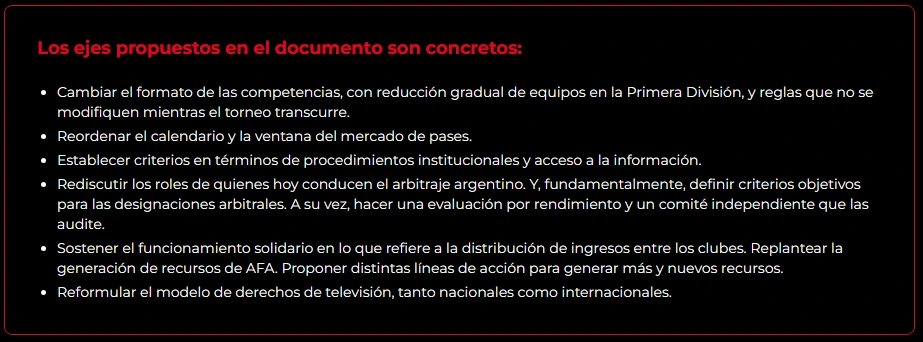
The first point is related to the format of competitions. River proposes a gradual reduction in the number of teams participating in the First Division and, at the same time, demands that the rules of the tournaments not be modified once the competition has started. The intention is to establish a more predictable structure for clubs and avoid changes in criteria during the course of a season.
River is going to propose a series of changes for Argentine football at the next AFA Executive Committee meeting
The second point addresses the calendar and the transfer market. The Núñez institution proposes to reorganize the dates of competitions and also establish a different planning for transfer windows, aiming for an organization that is more coherent with the development of tournaments.
The third proposal is linked to the institutional functioning of the AFA. River aims to establish clear criteria for internal procedures and access to information, seeking higher levels of transparency and predictability within the organization.
Refereeing constitutes the fourth axis of the document and one of the most specific demands. River proposes to re-discuss the roles of those currently in charge of refereeing and, additionally, establish objective criteria for defining appointments. This is complemented by the proposal to evaluate referees based on their performance and create an independent committee responsible for auditing that process.
The fifth point is related to economic resources. The club maintains that the solidarity nature of income distribution among institutions must be preserved, but considers it necessary to rethink the generation of resources for the AFA. In this regard, it proposes to develop new lines of action that allow for greater income and expand funding sources.
Finally, River proposes a reformulation of the television rights model. The proposal encompasses both contracts and resources from the national market as well as those related to the international exploitation of broadcasts, within a broader review of the economic scheme of Argentine football.
All the changes proposed by River
In addition to presenting these six axes, the Núñez entity frames its demands in its condition as a non-profit civil association. The club asserts that this characteristic implies working alongside other institutions to defend the interests of the members and stated: "The AFA is the heritage of the clubs and the clubs are the heritage of their members".
The document to be presented to the Executive Committee will serve as a basis for future projects. River explained that each proposal will be developed in greater depth and technical rigor, but with the intention of building modifications together with the other clubs and the various actors involved in Argentine football.