This positive evolution is the result of the successful economic plan promoted by Javier Milei's administration
Compartir:
Buenos Aires City recorded in the third quarter of 2025 a new reduction in poverty and extreme poverty levels, consolidating a downward trend that has already lasted for four consecutive year-on-year measurements, within the framework of the successful economic program of the Government of Javier Milei.
According to data released by the Buenos Aires City Institute of Statistics and Censuses (IDECBA), 13.7% of the households in the City, about 188,000, are below the poverty line, while 17.3% of the people, equivalent to 534,000 inhabitants, live in that condition.
The comparison with the same period in 2024 shows a significant improvement:there are 111,000 fewer households and 334,000 fewer people in a situation of poverty. This performance occurred in a context in which incomes managed to stay above inflation, a factor that directly influenced the recovery of living standards and the shift of broad sectors toward non-poor strata.
This positive evolution is the result of the successful economic plan promoted by the administration of Javier Milei, which drastically reduced inflation and increased real wages.
El presidente Javier Milei.
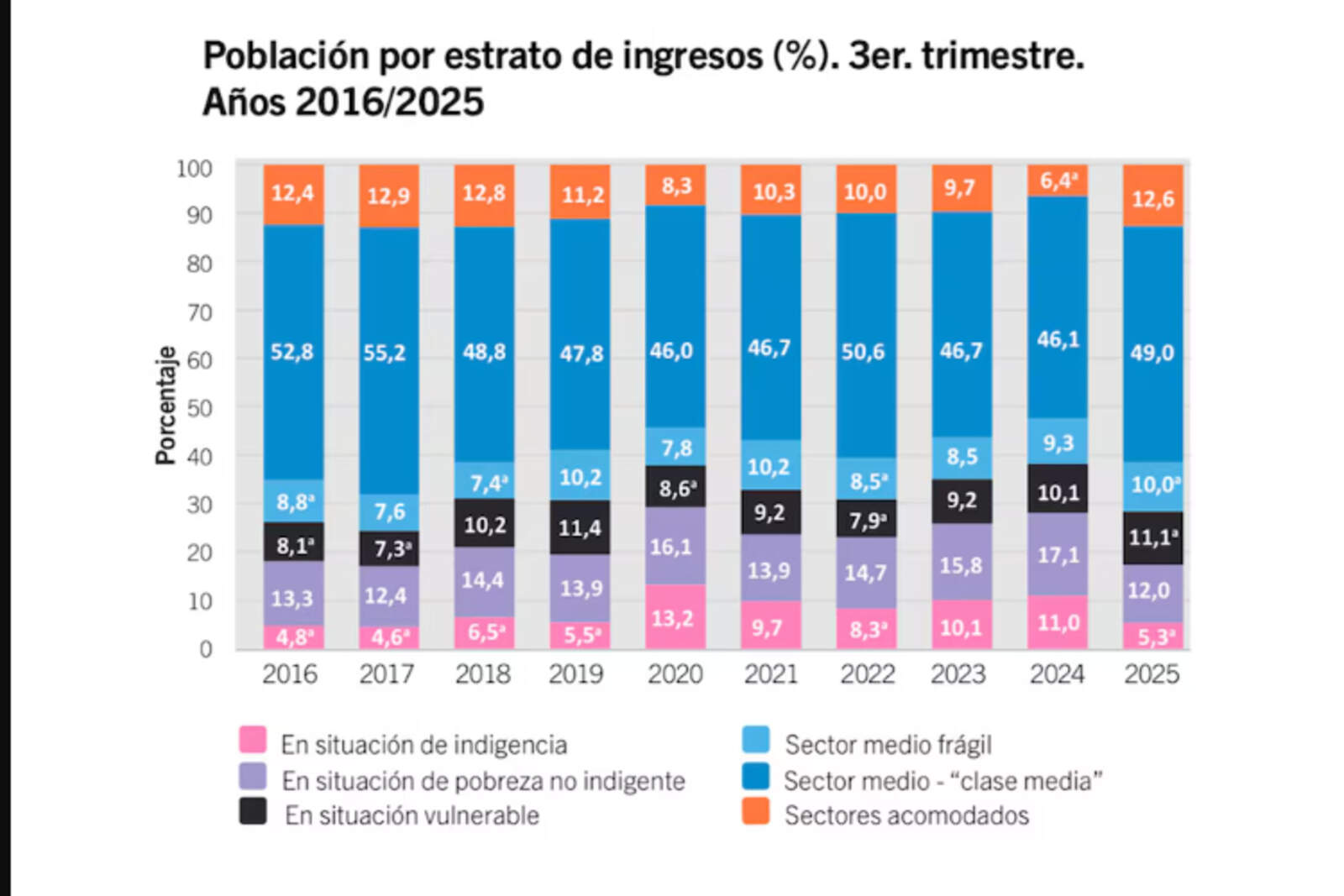
In parallel, extreme poverty also showed a decline. In the third quarter of the year it reached 4% of households (55,000) and 5.3% of people (164,000). IDECBA emphasized that the relative weight of extreme poverty within the universe of poverty decreased in year-on-year terms.
“Within the group of households and people in a situation of poverty, the weight of those who are in an extreme condition (extreme poverty) decreases in the year-on-year comparison, coming to represent 29.1% of households with income shortages and 30.7% of people in that condition”, the agency stated.
The report also warns that poverty isn't distributed homogeneously across the territory or among different types of households. The Southern Zone of the City continues to be the most affected area, with 21.8% of households below the poverty line.
Likewise, households with boys and girls under 14 years of age show an incidence of 22.6%, which increases as the number of minors in the household rises. In contrast, households with the presence of older adults record a lower incidence, of 12.1%, below the overall average.
Datos de la pobreza en CABA.
The impact is especially relevant in the child and adolescent population. According to IDECBA, 27.1% of children and adolescents between 0 and 17 years of age live in poor households, which represents about 190,000 people. One year ago, this indicator stood at 42.6%, which marks a sharp year-on-year drop.
Together with the reduction in poverty, the report highlights an expansion of non-poor households. Vulnerable households account for 9% of the total (124,000), where 11.1% of the population resides. Added to poor households, the group in a situation of vulnerability reaches 22.7% of households and 28.4% of people, a sharp decrease compared with the 38.2% recorded one year ago.
Above these groups, the fragile middle sector concentrates 9.8% of households and 10% of the population. The consolidated middle sectors, associated with the middle class, constitute the largest group: they bring together 51.4% of households and 49% of the population, with a year-on-year increase of up to 2.9 points, reflecting the impact of the current economic course.