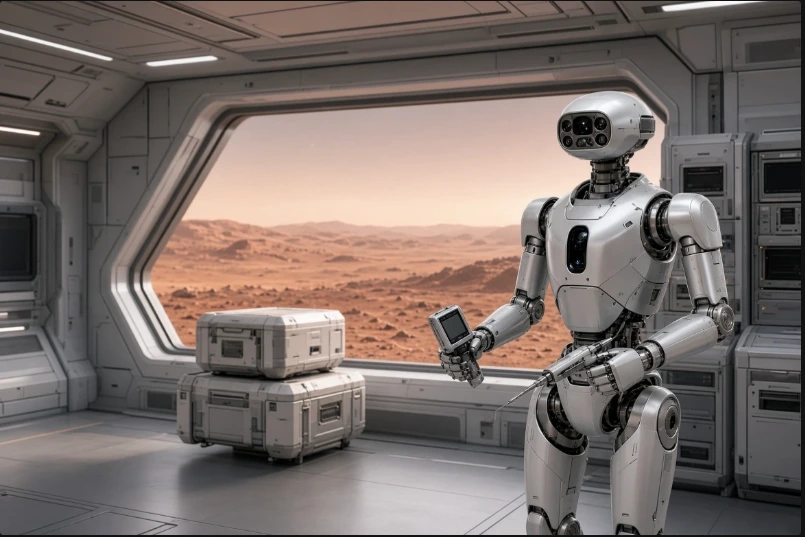
The system combines artificial intelligence and robotics for maintenance tasks, transporting equipment and supporting basic medical procedures during long-term trips
This ability to operate without relying on a permanent connection to Earth is essential. The robot also incorporates tools that allow it to interpret its three-dimensional environment and practice complex movements in virtual environments before acting in reality, aiming to reduce errors and ensure safety near people.
One of the biggest challenges of a crewed mission to Mars will be the delay in communications. According to the teams involved, a round trip of messages between the red planet and Earth can take up to 44 minutes. In an emergency, astronauts will not be able to wait for immediate instructions from ground control centers.
Autonomy and ongoing testing
For this reason, crew autonomy will be crucial. The robot aims to become a concrete physical support: to perform actions that an astronaut alone or with difficulties could not easily accomplish, without intending to replace medical judgment or make clinical decisions on its own.
The development is still in the research and testing phase. Over the past few years, the team has evaluated about 15 edge computing devices to find those capable of functioning with the lightweight, low-power hardware that Mars missions will require.
The ultimate goal is for astronauts to control it through simple voice commands, always under their direct command. This would eliminate the need for specialized knowledge in programming or robotics.
Space exploration is advancing towards a stage where robots are emerging as key companions for human crews. Google Public Sector, along with several NASA teams, is working on a robotic system designed to accompany astronauts on deep space missions, with a special focus on future trips to Mars.
On that planet, the vast distance from Earth will make an immediate response to technical or medical problems impossible. The robot is designed to take on maintenance tasks, organize tools, transport equipment, and assist in the care of the space modules.
Its role is not limited to logistics. It will also be able to provide physical assistance in basic medical procedures, such as taking vital signs or performing simple ultrasounds, always under the supervision of a crew physician.
illustrative image
The project involves NASA's Human Research Program, the Robotics team at the Johnson Space Center, and the Jet Propulsion Laboratory, in collaboration with Google Public Sector.
How the robotic system is designed
It is a versatile load manipulator, capable of interacting with objects in confined spaces. It can secure compartments, move tools, and adapt to different mission needs. The central idea is for it to change functions according to what the crew requires at any given moment.
To achieve this, it combines artificial intelligence, training models, and environmental recognition systems. Google uses instances of Google Cloud G4 to accelerate the learning of the models that control its movements. Once trained, these models can run locally on compact, low-power edge devices.