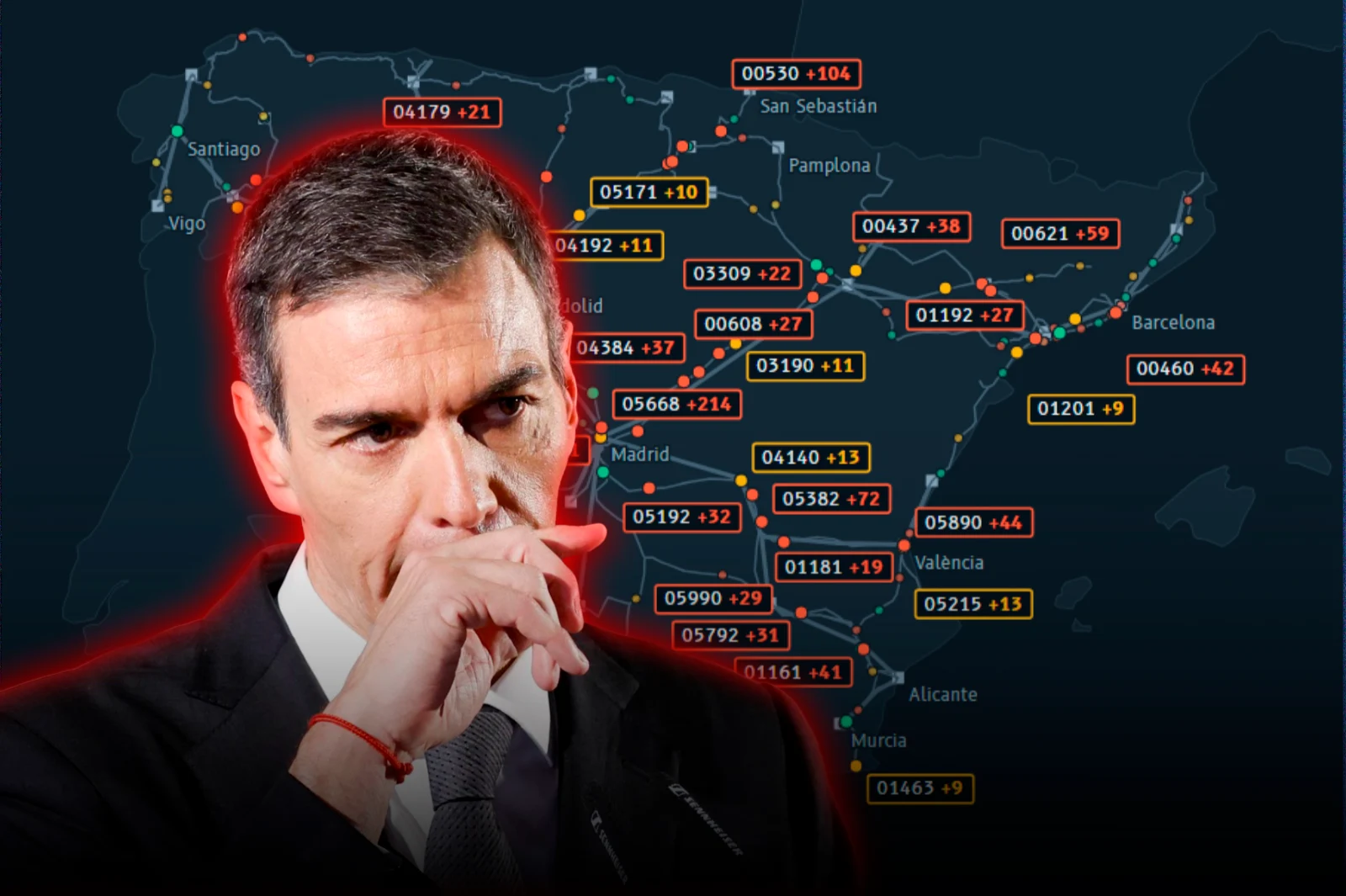
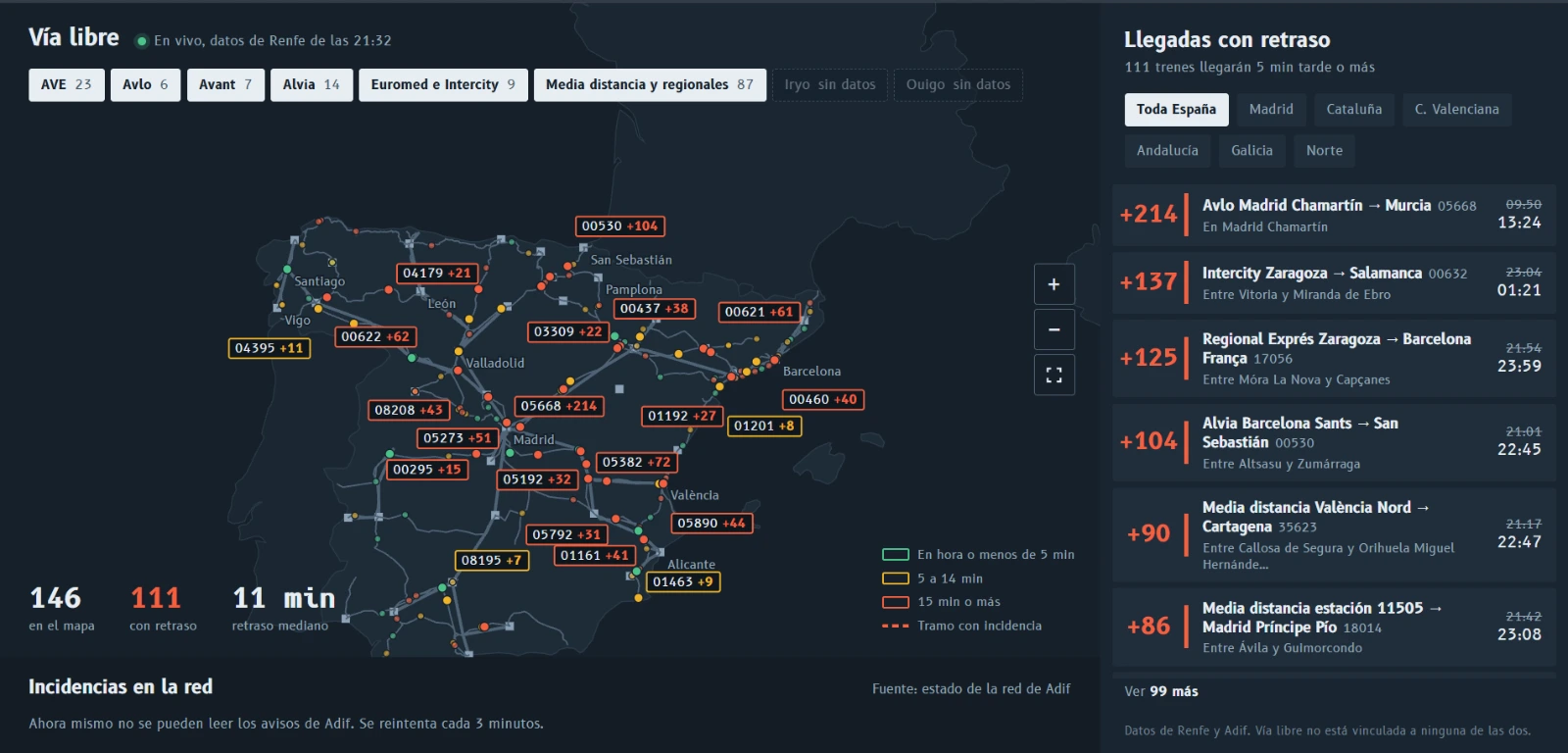
Upon launching Vía Libre, the developer found that 93 of the 119 trains operating at that time in Spain —almost 78%— were delayed, according to the GPS data collected by the website
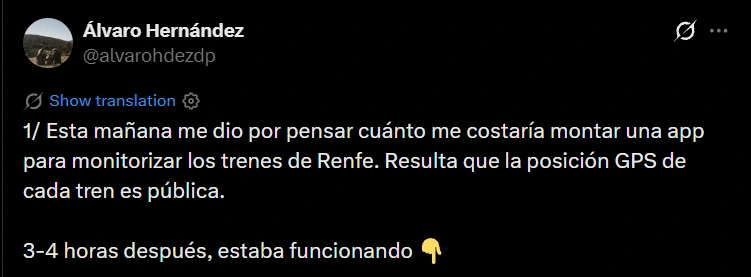
In just three or four hours of independent work, private initiative and citizen talent managed to discomfort the multimillionaire state apparatus of the socialist government of Pedro Sánchez. Spanish developer Álvaro Hernández (known on the X network as @alvarohdezdp), father of Margot and Cleo and interested in analog cameras and artificial intelligence, wondered one morning how much it would cost to design a tool to monitor the national network's trains in real time. After confirming that the GPS position of each train is public, he programmed the web application Vía Libre, accessible at vialibre.soft-flow.app.
The Vía Libre platform displays an interactive map that tracks AVE, Avlo, Avant, Alvia, Euromed, Intercity, medium distance, and regional trains. Using color codes to indicate delays, a list of late arrivals, and the collection of official incidents according to Adif data, the tool far surpassed the transparency of government applications.
The website of the Spanish developer, Álvaro Hernández
On the day of its launch, at 20:27, the application revealed that out of a total of 119 trains in circulation across Spain, 93 were delayed, meaning that nearly 78% of the fleet was running late simultaneously.
In light of the stark figures, Álvaro Hernández described the situation on X as “Crazy”. In his explanatory thread, the creator harshly questioned the inaction of public authorities: “2/ Seriously, has no one at Adif or Renfe thought to cross all the data with all available security systems, real-time GPS, and set up an alert system? Even with AI agents that anticipate possible problems”.
Furthermore, in response to the reactions generated, Álvaro Hernández clarified the nature of his political protest against the Executive: “5/ As I see many bitter people here, I’ll make it clear: I don’t intend for Spain’s trains to be controlled by a Paco-APP created in a morning. It’s a criticism of the lack of (political) will to innovate and create and use what already exists to improve safety”.
The Spanish developer, Álvaro Hernández
The snapshot revealed by the Vía Libre website exposes the background of a system degraded by the inoperability of the Minister of Transport, Óscar Puente, and Pedro Sánchez. In November 2022, within an official bidding document of 194 pages for a diagnostic train, Adif admitted in writing that the LZB signaling system of the LAV Madrid-Sevilla (in service since April 1992) was “obsolete” and “non-interoperable”.
The state agency acknowledged that this equipment “greatly hinders the provision of services by new operators to the detriment of competition”. To operate, private companies like Iryo and Ouigo had to install STM adapters (“Specific Transmission Module”), a process described by the sector as “a nightmare for engineers” and “an obstacle course and a marathon at the same time”, which delayed Ouigo's entry by 22 months until January 16, 2025 and similarly affected Iryo until March 31, 2023.
Oscar Puente
On October 5, 2026, the CEO of Iryo, Fabrizio Favara, stated before the Senate that the LZB caused constant stops: “it’s a safe system, but quite old, and every time the train's signal disconnects from the ground signal, the train stops. It cannot move, and it takes quite a while to reconnect and start the service again”. The inaction led to the disaster on October 28, 2026, at 8:54 at kilometer 118 between Los Yébenes and Urda (Toledo), when an AVE from Renfe traveling at over 160 km/h collided with a stopped Iryo, leaving the train “fractured” and a tragic toll of at least 69 people dead.
Just 1 day later, on Thursday October 29, 2026, an Ouigo train (formation 6775) between Murcia and Valladolid suffered “a catenary snag (power supply cable)”. The power cut left 454 passengers stranded in the dark and without air conditioning inside the El Regajal tunnel (Ontígola, Toledo), which is over 1 kilometer long. The 454 travelers had to be transferred to Madrid Chamartín or transported by bus to Segovia and Valladolid, while Ouigo offered compensations of 200% of the ticket. These events add to the accidents in Adamuz (Córdoba) on January 18, 2026 —with 46 dead— and in Gelida (Barcelona).