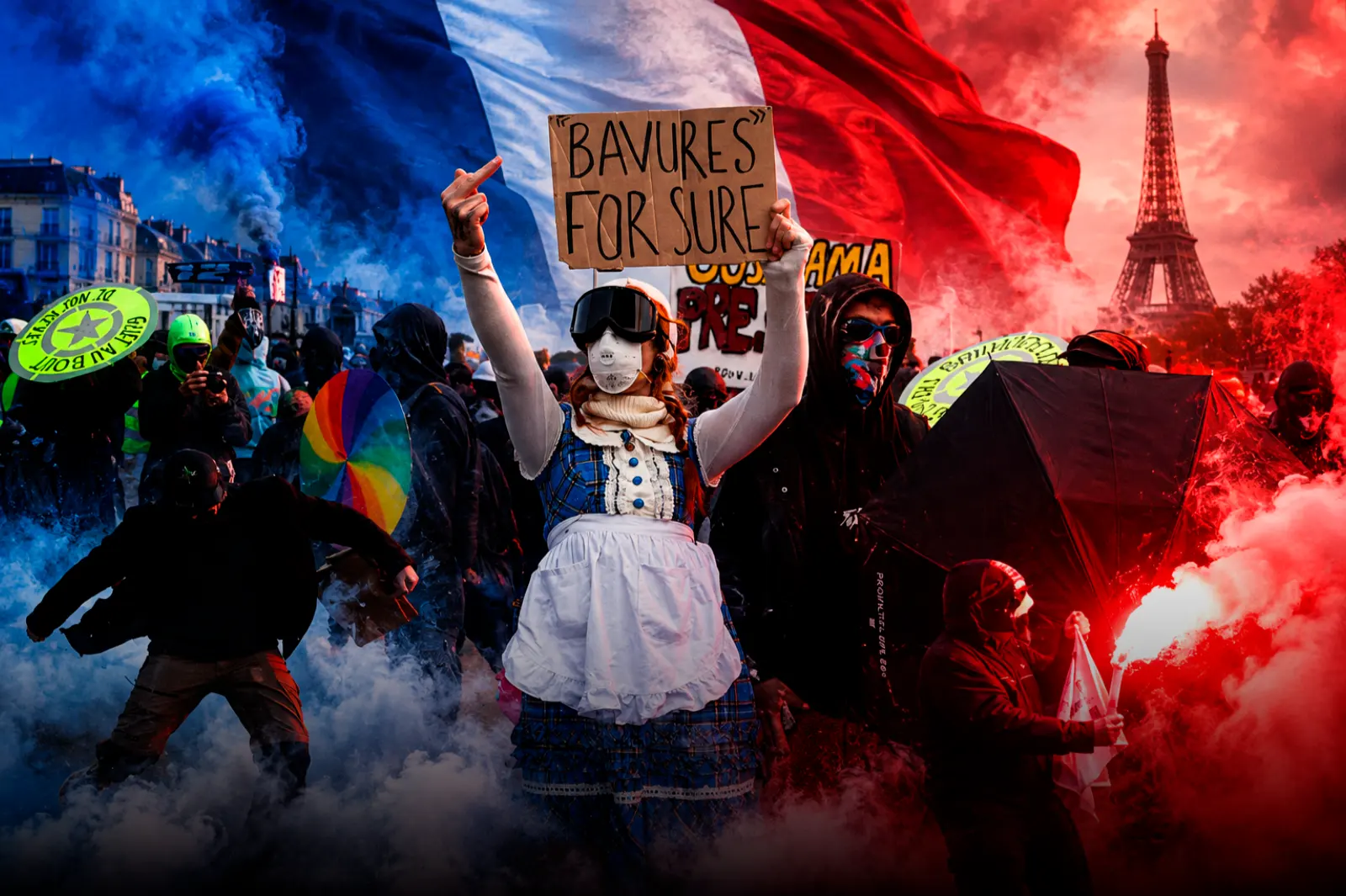
On the day of this Wednesday, France woke up engulfed in a general chaos due to the start of a general strike and massive protests across the country. In light of the magnitude of the protests and the risk of disturbances, the French Government deployed an operation with 70,000 police officers across the national territory.
For its part, the national intelligence services projected that between 500,000 and 700,000 people would mobilize in the outskirts of Paris. In the capital and other parts of the country, riot police had to resort to police charges and tear gas to disperse violent far-left groups that erected barriers and threw projectiles at the officers.
The impact of the mobilizations promoted by the General Confederation of Labor (CGT) and youth groups directly affected the education system. According to official data from the Ministry of Education, 17.5% of public primary school teachers joined the strike. In Paris, students blocked access to the Hélène Boucher Institute and other establishments by piling garbage containers at the entrances, which required police intervention to check the protesters and clear the access points.
In Strasbourg, serious altercations were reported outside the Marie Curie high school, where far-left protesters set garbage containers on fire until they were dispersed by the police with tear gas.
In light of the climate of insecurity, parents went to schools to safeguard the students. At the scene, Julie Souman, mother of a 49-year-old student, stated: “We are not here to dictate their movements or tell them what to do; they are the ones who decide and choose freely”. Souman indicated that the presence of parents aimed to prevent violent incidents, while banners with slogans such as “More money” and “Parents mobilized” were observed.
The paralysis of public infrastructure severely affected the economy and circulation in various regions of France. In the city of Lille, commercial activity was forced to close, with boarded-up shops reported at the Lille Flandres station and closed stores in the Euralille shopping center. Regarding regional transport, the report confirmed the suspension of half (50%) of the TER services in the north of the country.
At the same time, violence flared up in other localities. In Lyon, members of the antifa group set garbage containers on fire and erected barriers in the middle of the street. In Nantes, direct confrontations were reported between protesters and riot police, with the use of tear gas and satirical banners such as “Bravo, of course”.
The protests, organized by the CGT and the French Democratic Confederation of Labor (CFDT), focused their discourse on the deterioration of purchasing power, salary conditions, and the management of public services. The general secretary of the CFDT, Marylise Léon, stated in interviews for BFMTV: “We have indicators within companies, in various sectors, that show that people want to raise their voices”. Léon justified the measures of force by stating: “We have problems with purchasing power, we struggle to make ends meet. In fact, we even struggle to survive on our wages”.
However, this new wave of protests adds to the recent history of social unrest in the country, such as the disturbances and looting recorded on October 17, which caused severe damage to businesses and public buildings.