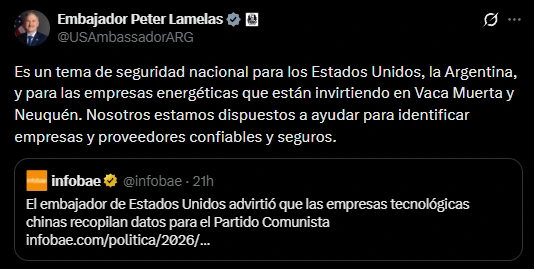
The United States ambassador to Argentina, Peter Lamelas, reiterated his stance on security in the energy and technology sectors with a message that focuses on Vaca Muerta and the province of Neuquén.
“This is a matter of national security for the United States, Argentina, and for the energy companies investing in Vaca Muerta and Neuquén. We are willing to help identify reliable and secure companies and suppliers,” the diplomat expressed on the social network X.
The statement comes amid growing tension regarding the involvement of technology companies in strategic projects, especially following warnings from Washington about the presence of Chinese firms in critical infrastructure and their role in espionage for the Chinese Communist Party.
The message from Peter Lamelas
Days earlier, Lamelas had formally expressed his concern in a letter sent to the Provincial Cooperative of Public and Community Services of Neuquén (CALF), in which he stated that Chinese technology companies collect data for the Communist Party.
The letter was a response to an institutional request from the electric distributor, after warnings emerged from the United States regarding a contract with Huawei for the deployment of a fiber optic network.
In that document, the ambassador stated: “As ambassador, my duty and priority is to protect national security and promote U.S. investment, which is intertwined with the growth and economic security of Argentina itself; it is in the spirit of goodwill and mutual interest that we have raised this issue with your cooperative.”
The conflict originated after a series of informal contacts. According to Sur Política, on July 12, a manager from CALF received WhatsApp messages in which a U.S. official inquired about the possibility of canceling the project and whether “limits had been crossed.” The situation was escalated to the cooperative's authorities, who decided to respond formally.
Peter Lamelas
On July 29, the entity sent a note to Lamelas, with a copy to the Ministry of Foreign Affairs, requesting clarifications on whether those contacts represented an official position, what legal backing they had, and whether there were specific technical objections.
The embassy publicly responded without denying the messages: “We do not comment on private diplomatic engagements. However, as Secretary (Marco) Rubio has emphasized, entry to the United States is a privilege, not a right.”
In that same vein, it was added that “The Government of the United States actively defends its national security interests and continuously reviews the eligibility requirements for visas,” and it was warned that “individuals and entities whose actions undermine the security of the United States will not enjoy the privilege of traveling to the United States.”
Subsequently, in his formal response to CALF, Lamelas reinforced his arguments by stating: “Companies subject to Chinese security and intelligence laws are required to hand over the data they collect, anywhere in the world, to the Chinese Communist Party.”
The diplomat also directly linked this concern to Argentine energy development: “Given the importance of Vaca Muerta in the local economy and CALF's primary role, we believe that protecting this data is a shared responsibility: a matter of cybersecurity and the competitive and long-term logic of the province, not just U.S. national interests.”
And he concluded: “Our role, as an Embassy, is to promote safe and reliable technologies, and we would appreciate the opportunity to discuss your technological plans, as well as offer technical assistance.”